B2B marketing has always loved certainty. Clear value props. Clear differentiation. Clear “why us.” A neat list of features, benefits and proof points that make a buyer feel like they’re making a rational decision.
But something is breaking underneath that framework. Software differentiation is collapsing. It’s easier, cheaper and faster than ever to build and ship software. Feature advantage now has a shorter half-life than ever. You can launch something on Tuesday and see a version of it in someone else’s roadmap by Friday.
That doesn’t mean product is irrelevant. It means product alone can’t carry meaning anymore. In a market where most tools look good enough on paper, buyers stop choosing what’s best and start choosing what feels safe. That’s where brand comes in — shifting from important to decisive.
Brand was never what a company said it was
Marketing teams have spent decades treating brand like a controlled narrative — as if it’s what you publish. The logo. The tagline. The voice. The story. The website. The positioning statement. All of it created with the hope the market will repeat it back.
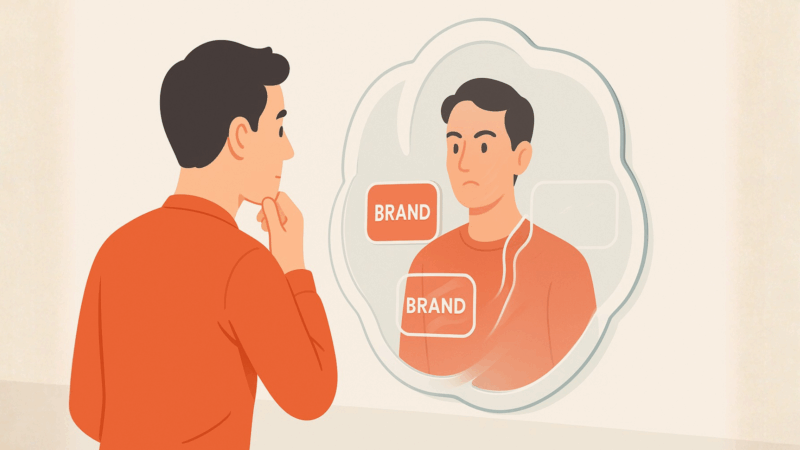
Brand has always lived elsewhere. It’s an expectation in a buyer’s mind — a prediction of what it will feel like to choose you, trust you and justify you. That expectation is personal, emotional and psychological. It goes far deeper than “do you have feature X.”
Brand is the quiet answer to questions buyers rarely say out loud:
- If I choose this company, will I look smart?
- Will this be painful to roll out?
- Will this become a career risk?
- Will this create a problem I can’t undo?
- Will I be stuck defending this choice six months from now?
That’s what brand has always been. A felt sense of certainty in an uncertain decision. What’s changing? The expectation is no longer forming in the places companies control.
Dig deeper: AI is paying off for B2B marketing. For B2B marketers? Not so much.
The shift is upstream
Here’s the real change: Buyers don’t show up curious anymore. They’ve already absorbed a baseline story about you before they hit your website or watch your demo. That story rarely comes from your positioning. It comes from everywhere else.
Think third-party review sites, community threads, Reddit, LinkedIn comments, niche Slack groups, YouTube breakdowns, podcasts, “best tools for X” posts, competitive comparisons. Perhaps the one angry implementation story that gets retold for a year or the one passionate advocate who brings you up in every conversation.
For a long time, that market chatter mattered, but it stayed messy. It lived across dozens of places, spread through word of mouth, took time to travel and depended on who you happened to know.
Even though the market always shaped perception, it moved slowly enough that companies could still control the first impression. That window is now gone. Market chatter no longer stays scattered. It gets consolidated and amplified by AI.
Dig deeper: 5 ways to strengthen your brand in the age of AI
AI turns consensus into a verdict
It’s no secret that AI is the reason this has changed so quickly. It takes thousands of disconnected opinions and turns them into a clean summary that feels like an objective answer. That’s the part that rewires your brand in an instant.
Your reputation used to spread through conversations. Now it spreads through conclusions delivered by an invisible spokesperson. A buyer asks a question, and AI produces the storyline.
- “Here’s who this company is.”
- “Here’s what they’re known for.”
- “Here’s what people complain about.”
- “Here’s how they compare.”
- “Here’s the risk.”
- “Here’s the upside.”
It delivers it with the confidence of a final draft. Even when the nuance is missing, the psychological effect stays the same. The buyer hears it as reality. Because AI doesn’t speak like a vendor, making claim after claim with minimal evidence to back it up. It speaks like the world that’s already lived your decision for you.
Brand shifts upstream again because the buyer walks in carrying a verdict that already feels settled. That verdict is shaped by the people who’ve been close enough to have an opinion. AI learns your brand from what the market keeps saying about you:
- Reviews and rating patterns.
- Long-form commentary buried in forums.
- Repeated phrases in social posts and replies.
- How competitors frame you.
- Employee sentiment.
- Customer language.
- Content that gets referenced.
- The details that show up over and over again, even if they started from one story.
This is why brand is becoming increasingly important. Setting the truest expectation and meeting it has never been more integral to success than it is right now.
The buying process used to feel like a first meeting. But now it’s the feeling of walking into a first conversation with someone who already has a fully formed read on you. From that point forward, everything you do is either confirming what they already believe or fighting uphill against it.
Dig deeper: Trust can’t be automated, and that’s why it matters
The standard serious brands live by
What do the brands that survive do differently? Stop treating brand like a department. Start treating brand like an organization-wide mission. Because brand is not your messaging, and it has nothing to do with your logo or colors.
Brand is your ability to create an expectation that stays true when reality shows up. It’s in the product, onboarding, support, billing and the gaps between handoffs. It shows up when a customer is stressed, confused, behind schedule or trying to prove internally that they made the right decision.
If you tell the market you can drive outcome X, you’d better be able to deliver it — not just in the best case, but in any scenario. Because your brand is built in the moments where the experience of your value proposition gets tested.
A buyer can forgive friction. They don’t forgive betrayal. Betrayal is what it feels like when expectation gets set high and reality shows up low. The best brands sell certainty.
B2B loves to pretend it sells features and functionality. But what buyers are really buying is the confidence that the result will happen. The features are the mechanism. Brand is the belief that the mechanism will work.
The new requirement for companies
In this AI world, your brand is no longer shaped by what you intended. Your brand is shaped by what your company can consistently deliver across every touchpoint, through every team, for every customer who shows up with real-world constraints.
AI is going to speak on your behalf, and you don’t get to approve the script. The companies that survive are the ones that build a brand where expectations remain true, no matter who is involved.
Over time, that consistency fuels the kind of reviews, chatter and word-of-mouth that matches the promises you’re making with your marketing in the first place. When AI describes you in three bullets, they’re the three bullets that won’t shoot you in the leg.
Dig deeper: The brands winning with AI know when to use it — and when not to
The post Brand is the decision in B2B, and AI decides first appeared first on MarTech.