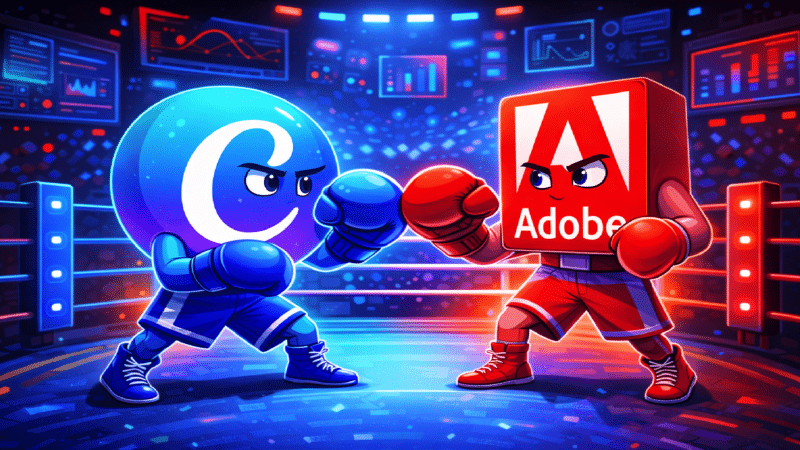
Adobe and Canva are heading in the same direction, even if they are taking very different paths to get there. Both companies rolled out major AI updates in the past 24 hours, and both are trying to redefine how creative work actually gets done.
At the center of both releases is a shift in interface. Design is becoming something you prompt rather than something you manually build, which changes how quickly work happens and who can do it.
Adobe’s Firefly AI Assistant update can take action within Creative Cloud, moving beyond generation into execution. Canva’s AI 2.0 leans into prompt-based editing across its platform, making design feel more like a conversation than a process.
The destination is the same, but the routes are very different.
Two strategies, same destination
Adobe is building on a complex ecosystem, adding an AI layer that helps power users move faster while maintaining control over detailed workflows. The assistant can edit files, coordinate steps and move between tools, which reinforces the depth Creative Cloud is known for.
Canva is doing what it has always done, simplifying the experience so users do not have to think about how the work gets done. You describe the outcome, and the system handles the mechanics behind the scenes.
That difference has not gone away with AI, and if anything, it is becoming more obvious as both platforms evolve. Adobe is extending expert capability, and Canva is expanding access.
The SEO toolkit you know, plus the AI visibility data you need.

This rivalry is more intense because it almost disappeared. Adobe’s attempt to acquire Canva was blocked by regulators, leaving both companies to compete directly. Since then, both have accelerated their roadmaps. Adobe is adding automation without losing its professional base, and Canva is adding capability without giving up simplicity.
They are not meeting in the middle, but they are getting closer from opposite directions as each expands into the other’s territory.
What marketers should expect
For marketers, the changes show up quickly in day-to-day work. Moving from idea to asset is faster, creating variations is easier and campaigns can be produced with fewer handoffs.
That does not remove complexity so much as shift it. The challenge moves from producing assets to deciding what to produce, aligning teams and maintaining consistency across a higher volume of output.
It also raises questions about control, since more people can generate more content without always following the same standards or processes.
Worth noting: Canva also announced an expanded Klaviyo integration today, which enables marketers to design and streamline full campaigns in Canva and reach consumers wherever they are. Marketers can bring Canva designs into Klaviyo to personalize, refine and deliver customer experiences at scale.
The interface is the battleground
The bigger shift is how these tools are being used, with interfaces moving away from menus and layers and toward systems that interpret intent. Instead of navigating features, users describe what they want and let the platform figure out how to deliver it. Call it Vibe Designing.
As that happens, competition becomes less about feature lists and more about how well each platform understands and executes user intent. That is where both companies are focusing their efforts.
Adobe is betting that depth combined with automation will win over professional users, while Canva is betting that speed and simplicity will scale across a broader audience.
Either way, creative work is moving toward a model where you describe the outcome rather than build it step by step, and both companies are trying to define what that future looks like.
The post Adobe and Canva releases push AI deeper into creative workflows appeared first on MarTech.