
Many SaaS stocks are plummeting. Vendors are shipping more features, and many are adding AI. But adding more features and layering in AI aren’t increasing the outcomes customers care about.
For two decades, SaaS grew by shipping features — more modules, more seats, and more functionality. Customers paid for access to what your product made possible.
That’s how SaaS scaled. It doesn’t hold up the way it used to. AI is revealing what was always there: Customers were never paying for your features. They were paying for the outcomes that those features helped them achieve.
Now, for the first time, those outcomes can be delivered in different ways. Demand is still growing, and the pie is still expanding. Yet SaaS vendors face pricing pressure, slower growth, and declining valuations. This reflects a shift in how value is captured.
The SEO toolkit you know, plus the AI visibility data you need.

AI is changing how SaaS gets priced
Chiefmartec and MartechTribe’s data show that most organizations aren’t ripping out their software stack. They’re layering AI on top of existing workflows and systems.

Most AI today enhances existing functionality. Only a small share replaces tools altogether. This shifts the question from “What will AI replace?” to something more uncomfortable: “What are customers still willing to pay for?”
The market is expanding, but SaaS is capturing a smaller share of that value. AI agents aren’t replacing SaaS. They’re absorbing part of its value by compressing the value of its features.
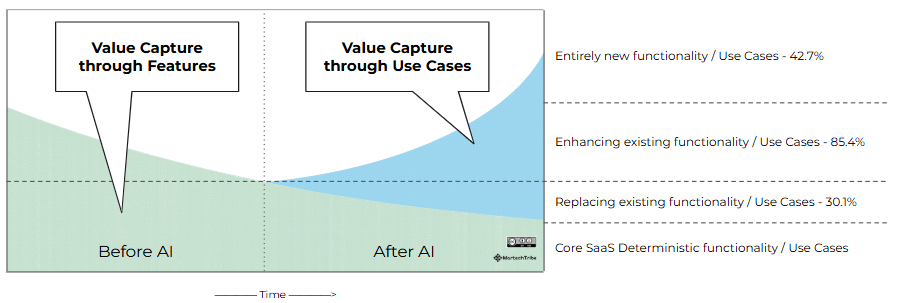
Anything that can be automated or generated becomes harder to differentiate and to price. What once justified a premium tier becomes expected. What required a module becomes a prompt.
AI strips SaaS down and forces a repricing — from features to outcomes, access to impact, and functionality to value delivered. SaaS vendors aren’t competing on who can build more, but on who can prove what is worth paying for.
Where value actually gets realized
Every SaaS product follows a familiar path: a user signs up, explores features, becomes activated, and, in the best cases, turns into a retained, expanding customer. But between activation and real, sustained value, there’s a gap.
It sits between what the product makes possible and what customers turn into outcomes — a space of under-realized, under-measured, and under-monetized value.
Historically, this gap was tolerated. Vendors optimized for feature adoption, customers accepted underutilization, and pricing remained tied to access rather than outcomes.
AI changes that dynamic because it operates precisely in that gap. It connects fragmented features into workflows, removes the need for expertise, and turns what only power users could do into something repeatable and scalable. In doing so, it accelerates value realization, often beyond the original product’s boundaries.
The product is no longer the bottleneck. Value realization is. The advantage shifts to those who help customers turn potential into outcomes faster.
Reduce to win: The new SaaS strategy
If the battlefield is the value gap, the move is to collapse the distance between feature and outcome.
Expanding the product now adds complexity faster than it creates value. In an AI-shaped market, every new capability competes with automation. The result isn’t differentiation, but dilution.
The shift starts by redefining the unit of value. Instead of tracking feature usage, focus on the outcomes customers repeatedly achieve. These already exist in your install base: recurring workflows, repeatable processes, and measurable business impact.
Next, collapse features into use cases. Customers don’t buy menus. They buy progress. Fragmented functionality needs to become complete, executable workflows — templatized, packaged, and usable without expertise. The product becomes less about navigation and more about execution.
Once the value is explicit, pricing follows. Seat-based and feature-tier models break down when usage is fluid and automation replaces effort. Pricing shifts toward outcomes: workflows executed, results delivered, value created.
AI will grow the software market, but it won’t reward feature volume. It will reward clarity. The vendors that win will be those who focus their product on what customers already prove is valuable and make that value undeniable.
The post Why SaaS is moving from features to outcomes appeared first on MarTech.