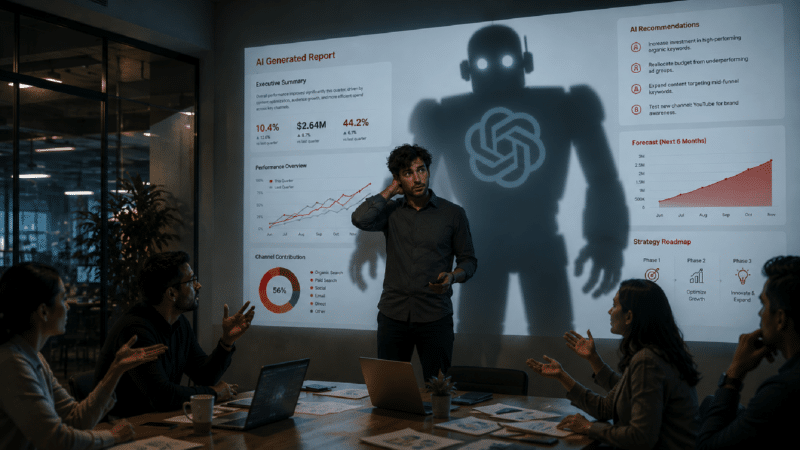
I’ve been seeing something lately, and now I can’t unsee it. At first, it felt like a series of small moments. Odd, but easy to brush off. Then it kept happening.
For instance, a client’s technical team was asked to provide notes to help me turn their expertise into a benefit-oriented content marketing piece. Instead, they delivered a full draft of an article. Great, right?
But when I asked them to go deeper on one of the concepts, there was a pause. They asked where it was in the document. They read it, took a beat. Then one of them said, “Ask Claude.” They both laughed.
That was the moment it clicked. They hadn’t just used AI to refine their thinking. They had used it to generate something they didn’t fully recognize as their own and couldn’t explain. In short, AI is making it easier to produce work, but harder to tell who actually understands it.
Once I started noticing it, I saw it everywhere.
- A student submitted an excellent final project. Clear thinking, strong structure, polished writing. Much better than any of her previous assignments. But many paragraphs had that telltale space at the beginning. I asked if she had used AI. She had. I told her she needed to disclose it, and she said she would. But I’m not convinced she mastered the material.
- A marketing agency I’m partnering with shared a deck full of detailed tables, charts, and timelines. It looked impressive. But when I asked questions, the answers weren’t there. At one point, the lead mentioned how great Claude is at building these.
I’m seeing more polished work than ever. I’m also seeing more people who can’t explain what they produced.
The SEO toolkit you know, plus the AI visibility data you need.

What’s actually happening
AI is very good at helping us produce output faster, cleaner, and more structured than we might create on our own. In many ways, that’s a win.
But we’ve started to confuse producing work with understanding work. Those are not the same thing. Increasingly, the gap between them is harder to spot. This is what I think of as the AI productivity illusion: when output improves, but understanding doesn’t.
Before AI, tools helped us execute on what we already understood. Now, AI can generate strategy, messaging, and analysis that look complete and credible, even when we don’t fully understand them.
This happens because AI can produce finished-looking work without requiring the user to process or internalize the thinking behind it. If we’re not careful, we skip that step entirely. That’s the shift, and that’s where things start to break.
Why this is a problem — especially for marketers
There’s a meaningful downside for marketers.
First, credibility starts to crack. If you can’t explain your thinking, you can’t defend it, and at some point, someone will ask. “AI suggested it” is not a strategy.
At the same time, strategy becomes… decorative. The outputs look right. Clean frameworks, detailed timelines, polished messaging. But without real understanding, they’re just artifacts. (Beautiful charts don’t count if you can’t walk someone through them.)
This also shows up in the work itself. When you don’t fully understand what you’re communicating, messaging loses its edge. You default to surface-level thinking instead of translating features into meaningful benefits or differentiating in a way that matters.
Finally, teams feel it. Questions get asked, answers are vague, and trust erodes. Quietly at first. But it adds up.
The telltale signs
Once you start looking for this, it’s surprisingly easy to spot. There are a few clues. Some have been around since the early days of ChatGPT (like the use of em dashes). Others are more subtle, but just as telling.
- Language that’s more polished than the person speaking.
- Vague explanations when asked, “Why?”
- Overuse of words like “optimized” or “strategic” without specifics.
- Outputs that look sophisticated but feel disconnected.
- Copy/paste artifacts (like the space at the start of paragraphs).
- My personal favorite: deferring to the tool.
But AI itself isn’t the problem. AI is incredibly powerful. I use and recommend it. This isn’t about rejecting the tool. It’s about how we’re using it.
Right now, in many cases, we’re copying rather than processing, skipping the thinking step, and treating AI as a replacement rather than a collaborator. That’s where things start to break.
How to use AI without losing understanding
The good news is that this is fixable. You don’t need to stop using AI. You just need to use it differently.
To use AI effectively without losing understanding, follow these four practices.
1. Don’t copy and paste. Re-type.
Yes, it’s slower. That’s the point. Re-typing forces you to process what you’re reading.
Re-typing exactly what the AI produced helps. Re-typing it in your own words helps even more, especially if your AI isn’t trained on your voice. If you can’t rewrite it, you don’t understand it yet.
2. Prove you understand it
Before you use anything AI-generated, pressure-test it. Can you explain it? Simplify it? Answer “why”? If not, you’re not done.
3. Use AI to build understanding
Don’t just ask AI to produce work. Ask it to explain, challenge, and stress-test it. Used this way, AI becomes a thinking partner, not just a content machine.
4. Add an understanding layer
Right now, many workflows look like this: generate, then deliver. What’s missing is the middle: generate, interpret, validate, and explain.
Skip those steps, and you get fast output. Include them, and you get work you can stand behind.
The bigger shift
We’re moving into a world where output is easy. When everyone can produce something that looks right, the differentiator is no longer the output. It’s the thinking behind it. It’s the ability to question, adapt, and explain.
That’s where the gap is starting to show. The people who stand out won’t be the ones who generate the most content. They’ll be the ones who actually understand it.
AI can absolutely make you more productive. But if you can’t explain what you’ve created, you don’t really own it. That’s going to matter more as AI becomes part of everyone’s workflow.
Disclosure: AI tools were used to assist in drafting and refining this article. All ideas and examples are my own, based on my experience and observations.
The post The dangerous gap between AI output and actual understanding appeared first on MarTech.