
Outbound marketing has shifted from large-scale static outreach to signal or event-driven, multichannel engagement.
When I was new at this and struggling to hit my numbers and looking for advice on what to do, I was told, “Just send more emails and make more dials.” Armed with that advice, I went back to my desk, opened my list builder, found 5,000 leads who fit our ideal client profile, and started the grind.
Historically, that was always the answer. “Just do more.” If you were to boil down the sales playbooks back then, that’s pretty much all it said. You relied on static lists based on the ideal client profile and a lot of repetitive tasks.
Today, that has changed. The new playbook focuses on buyer signals, tailored messaging, and coordinated channels to engage with the right people at the right time.
The SEO toolkit you know, plus the AI visibility data you need.

What has changed in outbound marketing
Here’s the thing that’s wrong with the old playbook these days: volume-only outreach no longer works. If you think turning up the volume on emails is the answer to a failing pipeline, you’ll be drowning in inboxes and languishing with no responses.
In the past, sellers controlled the sales cycle. We would reach out and tell the prospect that they had a problem, but that we had the solution. Today, it’s the buyers who are in control, and we have to be sure to meet them when it matters. Not with generic boring messaging about how amazing a product is, but with relevant and thoughtful messaging.
That’s because buyers crave relevance and not just personalization. Your messaging needs to be logical and personal.
For example, I received an email a while ago that was highly personalized. But the personalization had nothing to do with why that person was reaching out to me. He scraped my LinkedIn profile, found my history, location, and alma mater. The sales development rep (SDR) used all that information in the email to talk about how great the blueberry pancakes were at a big, on-campus cafe. The pitch he then made was for a solution that had nothing to do with the company I worked for at the time.
Hyper-personalized but not relevant.

Sales and marketing have historically been two separate functions within the business. They’ve typically been siloed and, at many companies, competitors. In today’s selling environment, it is imperative that sales and marketing are in lock step with each other, creating a unified motion that captures their prospects where they are with compelling and relevant content and messaging.
The move from static lists to buyer signals
If we can’t count on activity and volume, and the control of the sales cycle lies in the buyers’ hands, what do we do now? Buyers are hyper-aware of problems they have, and have the tools to research how to solve them. As a result, the roles of marketing and sales have shifted from pointing out issues to guiding toward solutions.
Intent data and compelling events are the king and queen of outreach. Having a well-defined ideal client profile is no longer enough. You must also understand the intent signals and the compelling events that drive demand among your prospects.
But what is intent data? Sure, it’s a hot buzzword, but I’m not sure everyone understands what it is. It is the observed actions of users taken online regarding content, searches, and websites that indicate their research into specific problems or solutions.
First-party intent data is captured through visitors on your website, followers of your LinkedIn page, content downloads, and form fills. Basically, any contact that starts from your own channels.
Conversely, third-party intent data is captured externally across sites, keyword searches, or scraping industry reports.
Compelling events occur around the time prospects feel pain or are ready for a change. Some examples of these events can include:
- Personnel changes.
- Hired a new C-level executive.
- Head of a department left the company.
- New product launch.
- New location opened.
- Completed funding rounds.
- New certifications.
- Industry violations
- Mergers and acquisitions
Having a system that listens for these events and intent signals and surfaces the leads to reach out to will help drive higher conversion rates once you act on those signals.
According to Instantly’s 2026 cold email benchmark report, cold emails are averaging a 3.34% response rate when using a static list with little to no signals. On the flip side, according to Salesmotion, a signal-based outreach sees responses in the 15%-25% range. This is why the days of just throwing more volume into your research are gone. Today, you need to be aware of the context in which your prospects are in the market to purchase.
Don’t rely on one or two channels to land your prospects
Have you ever tried to sit on a one-legged stool with your feet off the ground? Doesn’t end well, does it? If you are relying on one source for your leads, that’s basically what you’re doing.
I’ve spoken with countless founders and sales executives who tell me a compelling story about how they built their companies through referrals with no proactive outreach. One channel, good results, and a single point of failure. It doesn’t surprise me when the next phrase out of their mouth is, “Referrals have slowed down, and our growth has stalled.”
It’s easy to get comfortable with focusing on the channel that’s driving the most business growth. Don’t get comfortable. You have to focus on multiple channels to reach your prospects. These are things like:
- Paid media.
- Organic.
- Lead magnets.
- Cold email.
- LinkedIn and social media.
- Cold calling.
- Marketing emails.
Build the mix of outreach that resonates with your prospects. It’s no longer a question of last-touch versus first-touch attribution. It’s a matter of what’s in the mix.
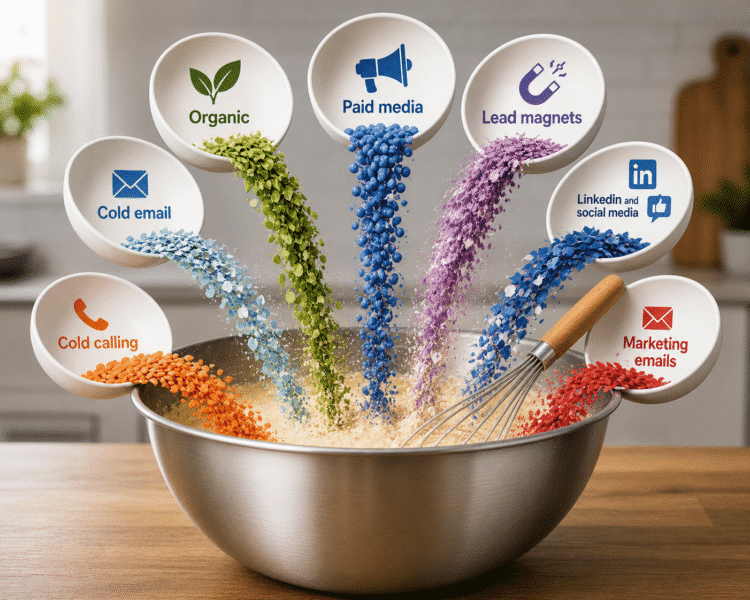
To do this well, you need to understand the role each channel plays, since not all channels have the same focus.
Factor15 gives a good example of the roles that each channel plays:

Understanding the different roles each plays will help to prevent mistakes like trying to shoehorn your email strategy into a LinkedIn outreach campaign or just throwing money at Ads without purposeful emails targeting the same audience.
Building your outreach strategy by blending the channels will increase your conversions. Let’s take a look at what this might look like in practice. Here’s a sample 12-week cocktail of outreach for a logistics company with a pain point of last-mile delivery cost overruns:
Week 1: Open on two fronts
- [Ads] Launch retargeting campaign: “Cut last-mile costs 20%” creative. The goal is passive exposure before any direct contact.
- [LinkedIn] Send a connection request referencing the shared logistics context. Keep it short, no pitch in the request.
Week 2: Warm the connection
- [LinkedIn] If connected, send a follow-up DM dropping a relevant industry insight. No ask yet. Build familiarity.
Week 3: Move to the inbox
- [Email] Send Email No. 1. Reference the LinkedIn connection explicitly. This is what separates it from cold spam. Tie it to a specific pain point (e.g., Southeast expansion → cost-per-stop spike).
- [Ads] Rotate creative to a case study ad: “3PL client reduced route cost by 18%.” Reinforce credibility in the background.
Week 4: Stay in the thread
- [Email] Send Email No. 2. Narrow the ask, one specific question about their Q3 ops targets. Shorter is better here.
Weeks 5-6: Stay visible, don’t push
- [LinkedIn] Engage authentically with their content. Comment with a genuine point of view, i.e., something more than “great post.” This keeps you in their feed without another direct ask.
- [Ads] Rotate to a webinar or event ad: “Route Optimization in 2026.” Plant the event seed before the formal invite.
Week 7: Deploy the trust accelerator
- [Event] Invite to a virtual roundtable with six ops leaders, 45 minutes, no pitch. Send the invite via both LinkedIn DM and email to maximize visibility. This is the highest-leverage moment in the sequence.
Weeks 8-9: Follow the momentum
- [Email] Send Email No. 3. If they attended the event, reference it directly and ask for 20 minutes. If they didn’t attend, use a softer value-add framing before the ask.
- [LinkedIn] Send a relevant resource article, framework, or data point. No ask attached. Pure value deposit.
Weeks 10-12: Close the loop
- [Email] Send Email No. 4: the break-up email. Be direct and respectful. Give them an easy out while leaving the door open for future timing.
- [Ads] Rotate to social proof creative, a testimonial, or results-focused ad. Let peers do the convincing if direct outreach hasn’t converted.
All of your channels should be orchestrated like a symphony. Sales and marketing need to be in lockstep on the targets, messaging, pain points, and coordination. Without that connection, what you’re sending to your prospects is simply cacophonous chaos.
Understanding your ideal customer profile (ICP) will tell you who to contact. Intent signals and compelling events tell you when to contact them. The channel mix tells you how to contact them.
Common mistakes to avoid
Nobody likes to be poked non-stop. A common mistake is when overly zealous sales or marketing reps send out many touchpoints in a very short period of time. To the prospect, it feels like they’re a mom whose toddler is nagging them for a new toy. Of course, these reps are coming from a perspective of wanting to stay in front of their prospects and be relevant, but it does the opposite. They will get themselves sent to spam and blocked.
On the other hand, don’t send overly generic sequences. You took the time to build your ICP, listen for intent signals and compelling events, and understand their specific pain points. Don’t send the same exact message to every single prospect.
Instead, create smaller, but much more tailored, messaging and campaigns based on those triggers and the ICP. You’ll have more sequences with fewer enrolled contacts, but you will see higher response rates and engagement.
The future of outbound marketing
It might seem overwhelming that so much is changing in how we reach our prospects. What worked five years ago, three years ago, or last year doesn’t work now. That trend is most likely to continue, and we need to be constantly mindful of how our prospects engage with us.
Today, the best way to reach people is to understand when they are ready to buy and to provide multi-layered outreach. Tomorrow might change, but by staying proactive, you’ll be better positioned to adapt.
The post How signal-based outreach is changing outbound appeared first on MarTech.