
A few weeks ago, I was reading OpenAI’s launch post for workspace agents when one detail stood out. They described the state of most enterprise AI adoption as “scattered prompts and half-built workflows” accumulated over two years. That’s a reality check straight from the company that triggered the AI boom in the first place.
Despite the headlines, most organizations still haven’t fundamentally changed how work gets done. AI can generate solid content in under a minute, but faster tasks haven’t automatically created faster organizations.
Most marketing teams spent the last two years doing exactly what they were incentivized to do. Each specialist figured out how to make AI useful within their own workflow.
The content specialist drafts newsletter snippets in ChatGPT. The designer generates brand-compliant graphics in Firefly. The email marketer built a QA workflow that saves hours every week. Managers use ChatGPT to sanity-check copy before it ships.
That’s real progress. But it’s also unconnected progress.
The SEO toolkit you know, plus the AI visibility data you need.

The workflow bottleneck AI didn’t fix
In my upcoming book, “Hyperadaptive: Rewiring the Enterprise to Become AI-Native,” I walk through a composite marketing team I call Meridian Digital. They’re tasked with turning a Monday morning blog post into a Tuesday email newsletter. In the pre-AI world, that work took four days.
With each person using AI inside their work, individual tasks got faster, but the newsletter still took four days to produce. The handoffs are still human. The waits between people are still human. The approvals are still human. Everyone got 30% faster at their individual task, and the overall process stayed the same.
That process is what local optimization looks like at the organizational scale. This pattern isn’t unique to marketing — any specialist team that has absorbed AI individually is likely to sit somewhere near this workflow.
When I share this example with marketing leaders, most say something along the lines of, “That’s almost exactly where we are.”
How to connect specializations together
The mistake I’m watching organizations make is assuming this bottleneck is a tool problem. It isn’t. Workspace agents, Jasper’s marketing agents platform, Copilot, and Claude Skills. All of these are meaningful platform-level progress, and they all give you somewhere to put the good work.
But the work of connecting specializations together isn’t a feature you can purchase. It’s a structural change, which is why so few of the 90% have graduated into the 10% seeing a real impact with AI.
When did your team last take an honest look at how much of your AI progress lives inside specializations rather than across them?
I’ve been building out a map of the journey organizations take from initial AI confusion to becoming AI-native. It has six waypoints, and the part that matters most for this conversation is the middle three.
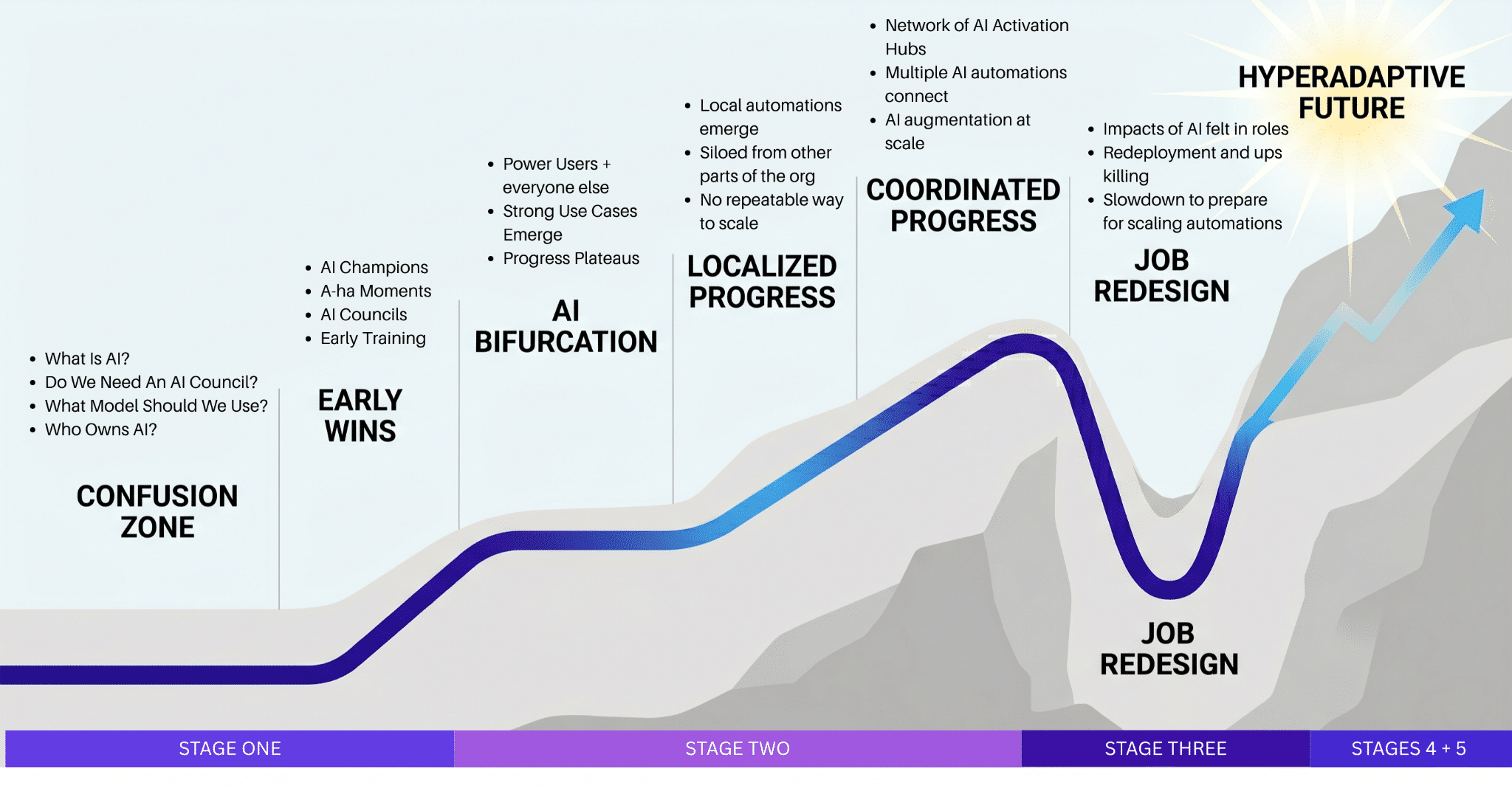
- AI bifurcation: Power users pull ahead of everyone else. Strong use cases emerge in pockets. Progress plateaus because the rest of the team is still figuring out what AI means for their role.
- Localized progress: Individual automations start showing up — one for content, one for design, one for reporting — but they’re siloed. There’s no repeatable way to scale them across the team.
- Coordinated progress: A network of AI activation hubs forms. Automations connect. The organization starts behaving as an AI-native system rather than a collection of AI-enabled individuals.
Most marketing teams I work with are sitting squarely between Bifurcation and Localized progress. They aren’t yet in Coordinated progress because nobody has been asked to own the work of connecting the specializations.
You can’t buy your way past that gap. You have to build it. That’s a role (I call it an AI lead), a pattern (the activation hub), and a cadence that turn winning workflows into shared infrastructure, review them, retire what isn’t working, and improve what is.
The Meridian Digital newsletter workflow looks very different when coordinated progress is achieved. In that scenario, the system detects the new blog post, drafts three newsletter variations, generates brand-compliant graphics, runs quality checks, and presents the options to the manager during her regular content review.
Lead time drops from 4 days to 1 day. Cycle time drops from two hours to one. Jobs evolve. The content specialist becomes an orchestrator of the content system. The designer shifts to visual direction and guardrails. The email marketer starts building the automations themselves.
Your next move
I leave you with this challenge. Look at the map honestly. Most marketing leaders I work with discover they’re a full stage behind where they thought they were, and that discovery is what makes the right next move obvious.
The post AI made marketers faster, but organizations stayed the same appeared first on MarTech.