
The 2025 MarTech Replacement Survey revealed a seeming contradiction: organizations are replacing fewer core platforms than at any point in the last three years, yet their stacks keep growing.
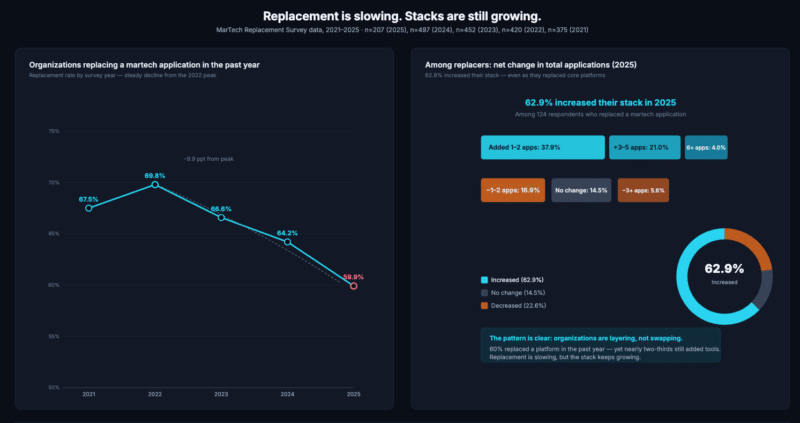
In the 2025 survey, 59.9% of respondents said they’d replaced a marketing technology application in the previous year. That’s down from 69.8% at the 2022 peak — a 10-percentage-point drop over three years. CRM replacements hit their lowest level in the survey’s history. Marketing automation replacements dropped from 31.1% in 2024 to 19.4% in 2025. Email platform replacements fell from 24.3% to 13.7%.
Those numbers seem to indicate replacement is slowing, and it’s slowing fast.
But the stack data tells a different story. When I isolated the respondents who said they’d replaced a platform, nearly two-thirds said their total number of applications increased over the past year.
Specifically, 62.9% of replacers added applications to their stack. About 37.9% added one or two tools. Another 21% added three to five. Four percent added six or more.
Only 22.6% saw their stack shrink. About 14.5% stayed flat.
That tension — fewer replacements, more applications — is the defining dynamic in martech right now.
Replacement without reduction
If organizations are replacing fewer systems, shouldn’t their stacks be stabilizing? Not if replacement and addition are decoupled — and that’s exactly what the data says is happening.
The traditional replacement cycle assumed a swap: one platform out, one platform in. The modern pattern looks more like layering. Organizations keep their core systems in place — CRM, marketing automation, email infrastructure — and add specialized tools around the edges. The categories with the most churn — SEO tools, analytics, marketing automation, and project management platforms — are also where point solutions are proliferating rapidly, making it easy to add without removing.

That pattern makes sense given the market environment. Replacing a marketing automation platform or CRM involves migration costs, retraining, workflow redesign, and integration work. Adding a point solution for SEO analytics or a lightweight project management tool is comparatively frictionless.
The result is a martech ecosystem shaped less by turnover and more by accumulation.
The integration tax
The problem with accumulation is that it doesn’t scale cleanly.
Every new application added to the stack creates additional integration points, more data silos, and more surface area for operational complexity. Our survey found that integration capabilities and data centralization were among the top selection criteria for replacement platforms — cited by 37.1% and 42.7% of respondents, respectively. Organizations clearly understand the integration burden.
The SEO toolkit you know, plus the AI visibility data you need.

But understanding it and avoiding it are different things. When 62.9% of replacers are still adding more tools than they remove, the gap between integration intent and stack reality appears to be widening.
This creates a particular kind of operational risk. Stack complexity tends to compound quietly. Organizations add tools in response to specific needs — better SEO performance, more granular analytics, a specific AI feature — without a corresponding effort to prune or consolidate. Over time, the stack becomes harder to manage, integrate, and secure.
The replacement slowdown might actually amplify this dynamic. When organizations hesitate to replace core platforms — because of cost, AI uncertainty, or high switching costs — they’re more likely to patch gaps with additional tools rather than address them through platform migration.
The rise of composable architectures — headless platforms, API-first tools, and the shift toward Scott Brinker’s “composable canvas,” where everything is “adjacent and adaptable” — has supercharged this dynamic. In a March 2026 research report with Databricks, Brinker argued that the martech architecture is moving away from rigid stacks and toward a model where apps and AI agents plug into a universal data layer. “This isn’t a rip-and-replace proposition,” he wrote. “It’s a three-to-five-year architectural vision.”
That helps explain the survey data. Composable architectures make adding tools nearly frictionless — bolt on a new analytics platform via API, wire up a headless CMS front-end, plug in an AI agent — without touching the core. But they don’t make replacement any cheaper. If anything, they make it harder to argue for, since the old logic of “swap the platform to get new capabilities” has been replaced by “add what you need around what you have”.
What this means for the next phase
If this pattern holds, the next few years in martech will be defined less by platform churn and more by stack management.
Vendors that help organizations consolidate — platforms that absorb adjacent functionality, integration layers that reduce connection complexity, tools that make existing stacks more manageable rather than adding another tile to the mosaic — may be better positioned than pure-play point solutions.
For practitioners, the message is more nuanced. Replacement hasn’t become harder to execute — it’s become harder to justify. Cost now dominates selection decisions (cited by 50.8% of replacers). Evaluation cycles have lengthened — nearly two-thirds of replacements spent three or more months under consideration, and 35.5% took more than six months. When the marginal gain from switching platforms shrinks, and the switching costs remain high, the math increasingly favors staying put.
But indefinite accumulation creates its own problems. Every new tool adds integration points, data silos, and operational surface area. The organizations that manage this well will treat stack growth as a deliberate choice rather than a default outcome.
The survey data doesn’t suggest that martech is shrinking. It suggests it’s getting messier — slower to replace, faster to add, and harder to wrangle. That’s not a contradiction. It’s the new normal.
Download the MarTech Replacement Survey
No registration required
Martech replacements took a dramatic turn in 2025 with many of the most-replaced apps from previous years finding stability. Get all of the details in this free report.
The post Why martech stacks are getting messier appeared first on MarTech.