
For 15 years, vendors built GTM systems to acquire customers and accelerate growth. They measured and optimized for what they could see, including closed revenue, pipeline, and new logos. Although GTM teams never intended to underinvest in retention, few made it hard for customers to leave.
That approach worked when scale was the moat. But customers can now use AI agents and automation to build workflows that once required expensive software.
As the GTM stack gets easier to replicate, leadership teams should ask a harder question: What protects your business when customers can rebuild your software independently? Retention increasingly depends on whether your product becomes part of how customers operate every day.
As James Clear wrote in “Atomic Habits,” “You do not rise to the level of your goals. You fall to the level of your systems.” The same idea now applies to GTM strategy.
The SEO toolkit you know, plus the AI visibility data you need.

Why rapid growth isn’t a true advantage for AI-native companies
AI-native companies are discovering the advantages of rapid growth erode quickly. ChartMogul’s 2026 retention report shows AI-native companies have a median net revenue retention (NRR) of 48%, significantly lower than the median NRR for B2B SaaS (82%). Shorter product cycles don’t automatically create deeper customer dependency.
Scale gets you into the account. Workflows determine whether you stay there.
Exhibit 1:
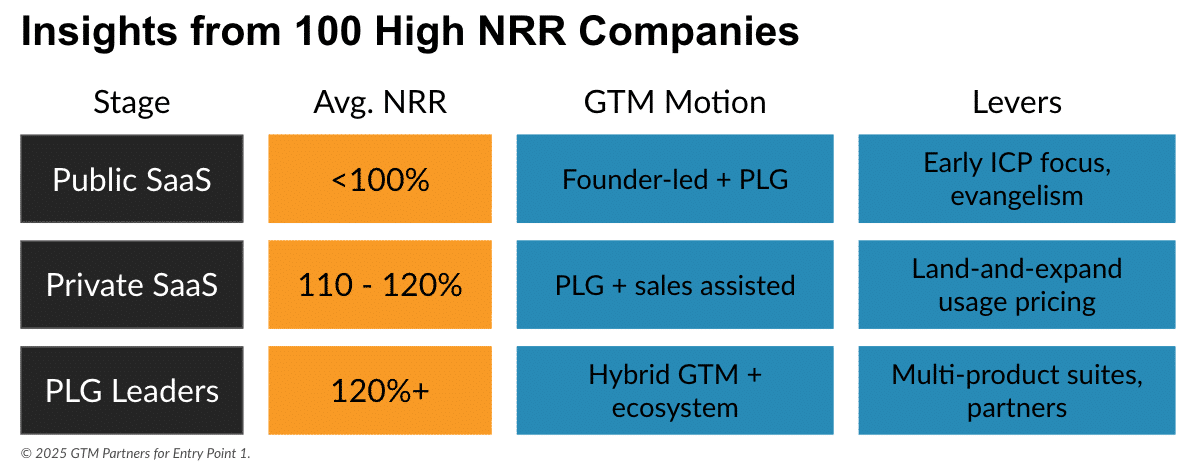
Top-quartile NRR performers trade at 24x enterprise value or revenue, according to a McKinsey analysis. In contrast, bottom-quartile peers trade at 5x. The reason is operational.
At 97% NRR, companies repeatedly spend money replacing revenue they already acquired. At 120% NRR, the installed base grows. The same acquisition investment keeps producing expansion revenue over time.
High NRR vendors rely on deep operational adoption
Vendors with NRR above 120% usually operate differently. They go far beyond campaign improvements to develop a different business model.
Product, customer success, sales, and marketing connect to customer workflows rather than isolated funnel stages. Expansion comes from deeper operational adoption, not just upsell pressure. The product becomes harder to remove as teams reorganize around it.
Latané Conant, CMO at Parloa, concisely explains who owns customer experience end-to-end. “Everyone plays a part, but no one truly owns it,” she says in a LinkedIn post. She frames it less as a management problem and more as a design problem.
Ryan Hinkle at Insight Partners describes the difference directly. “The key question is: What is a system of record? If it’s just a filing cabinet — a digitized storage system — that’s a problem. If it’s a true system of action or work, where knowledge workers can’t do their jobs without it, that’s very different.”
Why vendors must become integral to customer systems
AI can replicate your stack, but it can’t replace your customer’s operating process. This is the system layer of the 4S Framework.
Veeva built it inside life sciences. The company embedded software into regulatory and clinical workflows, where replacement requires retraining teams, rebuilding processes, and navigating recertification requirements.
Procore built it in construction. Contractors, subcontractors, and owners operate inside the same environment. Removing the software impacts the workflow of the entire project ecosystem.
Rockwell Automation built it in manufacturing. The company deeply integrated programmable logic controller (PLC) infrastructure into production environments where replacement simultaneously affects operations, training, compliance, and uptime.
The real test of customer dependency
Scott Brinker and Frans Riemersma’s State of Martech 2026 shows that 176 content marketing vendors disappeared from the landscape in a single year. These products weren’t necessarily technical failures. Instead, customers churned because doing so didn’t materially change teams’ workflows.
This is increasingly the test. What would your customers lose if you disappeared tomorrow?
Think about Clear’s idea of systems as a business architecture decision. If your customer can leave without reorganizing their team, your position is weak.
Companies building for system usually do three things differently.
Exhibit 2:
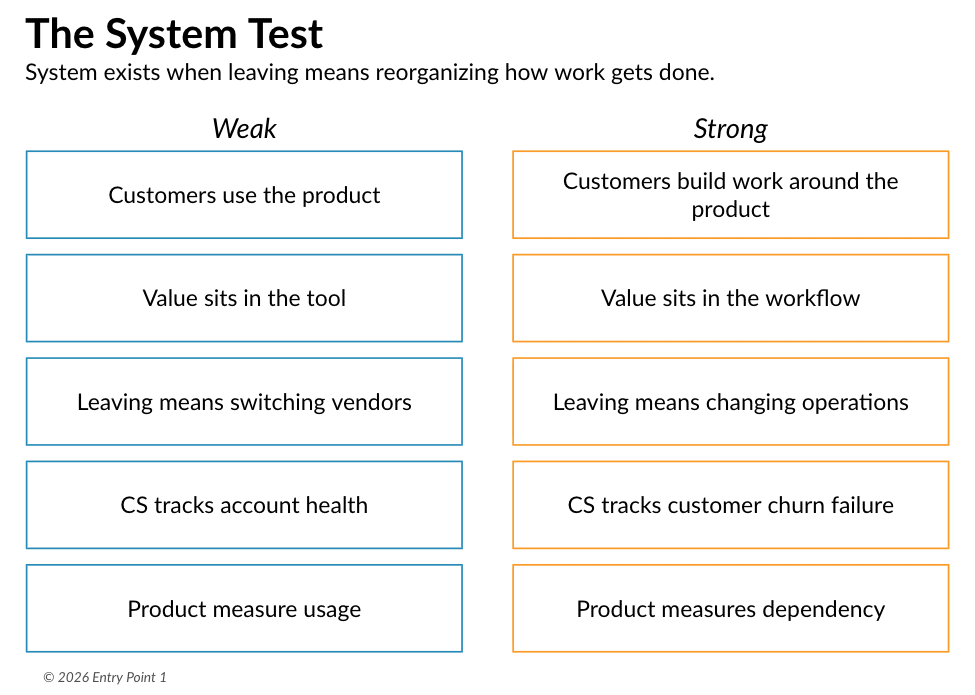
Marketing listens for operational language. Customers who describe the product as part of how they work signal something very different from those who consider it simply a tool.
Customer success documents should document workflow dependencies, not just account health. Which operational process breaks if the customer leaves? The answer is often a better retention indicator than net promoter score.
The product evaluates the removal cost during roadmap planning. If customers could replace the product tomorrow without rebuilding workflows, retraining teams, or changing operating behavior, system is shallow.
The vendors that win optimize for acquisition and retention
The vendors creating a defensible GTM advantage do much more than optimize for acquisition. They build products and workflows that customers reorganize around.
As tooling advantages become easier to replicate, operational dependencies become harder to replace than software itself.
The post Scale gets you in the door, but workflows keep you embedded appeared first on MarTech.