
I sit through a lot of vendor pitches and conference keynotes. After enough of them, the slides blur. AI-powered routing. AI-powered insights. AI-powered content. By the third talk, you can’t tell whether you’re being sold the same product four times or four products once. The term is broad enough to cover anything, which is the problem. It tells you nothing about what you’re buying.
I don’t think we’ll be saying AI much within a couple of years, at least not the way we do now. Jay Pattisall and Mike Proulx at Forrester made the point recently: It’s the same arc as electric. Everything was an electric [whatever] until it wasn’t. We put food in the fridge, not the electric fridge.
There’s something useful in being specific about why you’re retiring the term because it’s not going to fade away elegantly on its own. Electricity left our vocabulary because we stopped paying attention to it. It just works. You plug something into an electric outlet, and you get the same current whether you want to or not. If it doesn’t work, you know something’s broken.
Many AI systems will remain probabilistic. Instead of a lightbulb failing to turn on, AI will fail silently, and overconfident incorrect answers look just like overconfident correct answers unless you’ve done rigorous testing and governance. AI will start to be phased out of low-stakes ambient uses and will cling to the ones where there’s real money on the line for being wrong: diagnosis, credit scoring, and legal liability.
Four capabilities, not one category
Dropping the term isn’t simply about avoiding the overuse of a buzzword. That matters significantly less than the conversations that don’t happen when we instead use an umbrella term that conflates overlapping but nuanced activities and actions. Underneath “AI” sit four different things a marketing, CX, or service system can actually do. Name which one you’re buying, and your decisions, ownership lines, and processes get sharper. Eventually, so does the customer’s experience.
The world’s most powerful SEO platform, purpose-built for Enterprise.
Stop worrying about what some platform’s AI means. Break it down into four piles: generation, augmentation, insights, and orchestration.
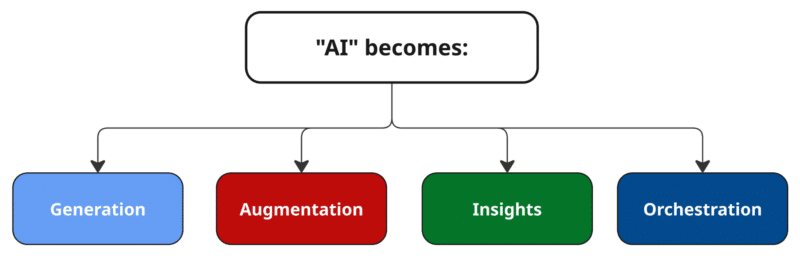
1. Generation
When the machine produces the artifact, which is the product, and humans need not be the author. Emails in the millions, each personalized for one individual. Synthetic test data that wouldn’t be possible to collect from the real world. Designs crowdsourced across billions of possibilities that no human would ever draw by hand.
2. Augmentation
The second set of hands for a human who still controls the workflow. It’s the real-time assistant that composes a service response. It’s the tool that helps your analyst prototype working models faster. Augmentation contains the largest volume of the four categories. It quietly devours most of what people claim as AI creativity. Augmentation is less a technology than it is a posture. The work still ultimately gets done by a person. They can just do more.
3. Insights
This capability feeds a decision. Sometimes at the front of a process (predictive: propensity scoring, churn risk), sometimes at the back (analysis of work already done). The output is understanding, and someone still has to act on it. When that someone is another system, you’ve handed off to the fourth bucket.
4. Orchestration
This capability coordinates activities across systems, tools, and agents. It exists on a spectrum of supervision: all steps individually approved by a human at one extreme, fully autonomous at the other. Autonomy is simply the far end of the dial, not something to purchase on its own.
Most real deployments are two or three of these capabilities at once, and that’s fine. Next-best-action, for instance, is an insights model that feeds an orchestration engine on purpose. The point of naming them isn’t tidiness. A vendor selling you AI gets to dodge which one they actually do. A vendor selling you “an insights model feeding your next-best-action engine” can’t.
You’ll notice this says nothing about AI search, generative engine optimization (GEO), or AEO, on purpose, despite those being pretty hot topics for many marketers. Those are customer behaviors: how people find you through an answer engine. The AI umbrella I’m talking about covers the tools your own teams operate, not the ones your customers do: different problem, different article.
Where the four capabilities overlap
The two capabilities most likely to be conflated or mixed up are augmentation and generation because both produce something. I use one question to sort them, and it works on anything:
Remove the AI. Could a skilled person still make this, just slower, smaller, or rougher?
Yes means augmentation. “Write this in my voice.” “Draft the contract.” A skilled human does both unaided. The AI amplified an author. No means generation by itself: the thing exists only because a machine worked at a scale or dimension that no human authoring loop can reach. A million individually tuned emails. Training data no one ever gathered. No person was going to hand-author those.
The line is authorship. A skilled human could have written the first set. No one was ever going to write the second. Augmentation is about who’s in the seat. Generation is about what got produced. They stack constantly. The everyday “the AI made me a thing” is usually generation working for a human author, and the test still tells you which conversation you’re in.
How to decompose AI into more meaningful functions
It doesn’t take a highly technical person to do this well. Take AI-powered subject lines, for instance. Pull it apart in three ways:
- Capabilities: Generation does the writing, in service of augmentation. A marketer still owns the campaign and approves the send.
- The mechanism: A generative model, sitting where a rule-based template or a plain A/B test used to sit. (Mechanism is the how behind the capability: rules, prediction, generation, or an agent. Whether this one earns its seat is a fight for the next piece.)
- The cost of being wrong: Does anyone read the variants before they reach a customer? Failure in this case is a clever subject line that’s subtly off-brand or flatly wrong, going out at scale because it reads fine at a glance.
That’s one feature and three separate conversations, and none of them happen while it’s filed under AI-powered.
What you can do next
Start by applying the framework to the AI initiatives and tools already in your organization.
Re-tag every current AI initiative by one of the four capabilities
The duplicate spend surfaces almost immediately once the lines stop all reading AI. I’ve watched stack audits turn up clusters of tools solving the same problem, a couple of which were switched off months earlier but still incurring charges. You can’t catch that while every line says AI.
Use the names to assign owners
“Who owns the generative content pipeline?” has an answer. “Who owns AI?” has a committee. Precise language is the precondition for accountability and for a budget line your CFO can actually defend. If you don’t own the whole stack, that’s fine. You own the naming, and it’s what forces the rest of the org to show its work.
Next time a slide says AI-powered, don’t ask what it’s powered by. Instead, ask which of the four it does and what it costs you when it’s wrong. Vendors benefit from the broad AI label. You benefit from knowing exactly what the technology does and what happens when it fails.
The post Stop buying AI and start buying capabilities appeared first on MarTech.