For years, Google has used the E-E-A-T framework to assess the quality of web content. The acronym stands for Experience, Expertise, Authoritativeness, and Trustworthiness.
Google recommends that content creators follow E-E-A-T principles because they signal value to searchers and align with what Google’s search algorithms are designed to reward.
Another long-standing Google framework is Relevance, Distance, and Prominence. Google identifies these three signals in its document, Tips to Improve Your Local Ranking on Google, as the primary factors that influence local search rankings.
Frameworks like these can help you identify what to improve to boost search rankings. But until now, there hasn’t been a comparable framework for AI visibility or one that reflects the priorities of multi-location marketers across search, social, reputation, and AI — the integrated approach we’ve come to call search everywhere optimization.
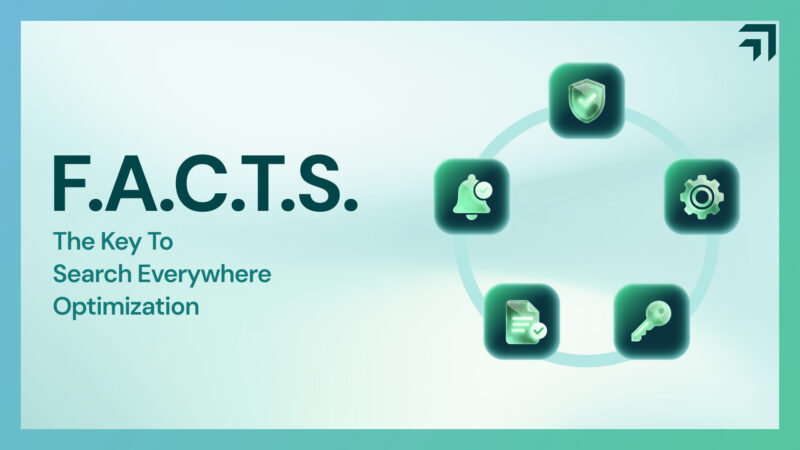
That’s why we developed the F.A.C.T.S. model. F.A.C.T.S. stands for the five factors we believe matter most in a holistic strategy: Freshness, Authority, Consistency, Trust, and Semantic Relevance.

Freshness
Freshness refers to how recently you publish content on your website and third-party profiles like Google, Yelp, and Facebook. Fresh content matters to people, and search engines and AI platforms also strongly favor it.
The average URL cited by AI platforms is 25.7% newer than those cited in traditional search, a recent Ahrefs study found. More than 70% of AI-cited pages were updated within the past 12 months, according to AirOps; meanwhile, 76.4% of ChatGPT’s top-cited pages were updated within the past 30 days, SE Ranking found.
Authority
On this point, our model is similar to Google’s. Authority reflects how a brand demonstrates leadership in its industry.
For example, if you’ve been in business since 1963, listing that in your Google profile signals authority. Trusted sources can also reinforce it, including professional certifications, best-of lists, and positive coverage in online publications.
Because authority is a complex signal, definitive research on its importance can be hard to find. Its inclusion in E-E-A-T underscores its significance, and Google’s Prominence factor in local search describes a similar concept.
Brands publishing authoritative content in their area of expertise and earning recommendations from trusted online sources are 40% more likely to appear in AI answers than brands missing either factor, AirOps found.
Consistency
In local visibility, consistency has evolved. It once meant listing each location’s name, address, phone number, and website uniformly across as many directories as possible. As the directory landscape contracted and Google grew dominant, these long-tail citations became largely irrelevant.
But AI’s need to ground answers in trusted sources has renewed the importance of managing your brand’s presence across multiple platforms — not hundreds of directories, but the handful of sources AI platforms are most likely to cite for local queries.
Google Maps, business websites, Yelp, and Facebook (in that order) are the sources most often cited for local queries on ChatGPT, Gemini, and Perplexity, SOCi’s research indicates. However, top sources vary by industry, and individual brands may have citation profiles that differ from the norm.
Our Local Visibility Index shows that inconsistency is a key driver of inaccurate AI mentions and weak brand visibility. While 98% of the brand locations studied had claimed Google profiles, only 80% had claimed Yelp profiles, and just 53% managed Facebook store pages. As a likely result, LLM citations for local brands are only about 79% accurate.
Trust
We use trust to describe signals from outside the brand that reflect approval from both consumers and experts. In local search, trust is conveyed largely through ratings and reviews on platforms like Google and Yelp, which AI platforms use as a primary factor when recommending local brands.
Our Consumer Behavior Index shows that 92% of consumers consult online reviews when choosing a local business. Reflecting this behavior, AI tools use reviews to assess how highly customers regard a brand. The Local Visibility Index found that businesses recommended by ChatGPT average 4.4 stars, compared with 4.2 stars on Google and 3.1 stars on Yelp. AI platforms are setting a higher standard for inclusion in a more selective set of results.
Semantic Relevance
Like authority, semantic relevance is complex but can be summarized with one question: Does your brand — across its website, local landing pages, online profiles, and posts — answer every question ideal customers may have before choosing it over a competitor?
As with many F.A.C.T.S. factors, this matters more than ever in an AI context. The average traditional search query is four words, while the average AI query is 23, according to Orbit Media. Consumers using AI ask longer, more nuanced questions, so brands must create detailed, useful content to avoid exclusion.
F.A.C.T.S. is a filter through which all optimization opportunities should be evaluated
Most marketing teams don’t have time to chase every algorithm rumor. You must prioritize the optimizations with the greatest impact. This is where F.A.C.T.S. becomes a practical, daily tool for your team.
Before investing in a new local marketing tactic or content update, run it through the F.A.C.T.S. filter. Ask:
- Does it provide an immediate or ongoing freshness signal?
- Does it establish our business as an industry authority with clear evidence?
- Is it consistent with our brand’s source of truth?
- Does it create an opportunity to strengthen trust signals?
- Is it semantically relevant to a specific local customer need?
If an opportunity doesn’t meet these criteria, move it to the bottom of the priority list.
How can F.A.C.T.S. be applied to your brand’s marketing strategy?
At the brand level, the F.A.C.T.S. filter helps you build an error-free foundation that strengthens relevance and prominence across your location network. Your team manages the core data, technical health, and brand-wide signals.
By securing these elements centrally, you help every location pass an algorithm’s baseline risk and confidence checks:
- Freshness: Keep the brand’s digital pulse active across the network. Use feeds to push seasonal updates and national promotions to local pages and listings. Archive outdated content and use APIs to keep core operational information current, signaling that the network is active and valid.
- Authority: Use the strength of the brand domain to provide comparative data and evidence of expertise. Connect every local page to the authoritative main website. Feature national press coverage, industry awards, and original research to support the brand’s claims at scale.
- Consistency: Build algorithmic confidence by serving as the single source of truth. Audit data aggregators, claim major directory profiles, and suppress duplicate or rogue listings. Consistent data reduces the risk of being filtered out.
- Trust: Support the algorithm’s risk assessment with a secure, technically healthy website. Use compliant, automated review-request workflows that avoid incentivization. Monitor recurring poor customer experiences and spam attacks before they damage brand trust.
- Semantic relevance: Move beyond basic catalogs with an intent-based content architecture. Create dedicated service pages and comprehensive FAQs that address the meaning and common pain points behind customer queries. Structure the corporate site around the definitive solutions AI tools are likely to cite.
The F.A.C.T.S. advantage
Ultimately, F.A.C.T.S. reflects a simple consumer instinct: brands that are current, credible, consistent, trusted, and genuinely useful earn visibility across search, social, and AI. Whatever the research shows, brands a
The post Why the F.A.C.T.S. model is the key to search everywhere optimization appeared first on MarTech.