B2B marketing budgets are influenced by data that fewer than half of the people responsible for measuring marketing and communications fully trust.
Only 49% of respondents are very confident in the accuracy and completeness of their data. Yet measurement influences strategy or budgets for 88% of respondents in paid social, 87% in paid media and digital, and 85% in owned content, according to a new study from 10Fold.
The study, “The Communications ROI Reset: What B2B Leaders Measure, Trust And Act On,” surveyed 400 people responsible for marketing and communications at companies in the U.S., U.K., France, and Germany. Respondents included C-level executives, directors, department heads, and managers.
Teams have the data, but struggle to connect it
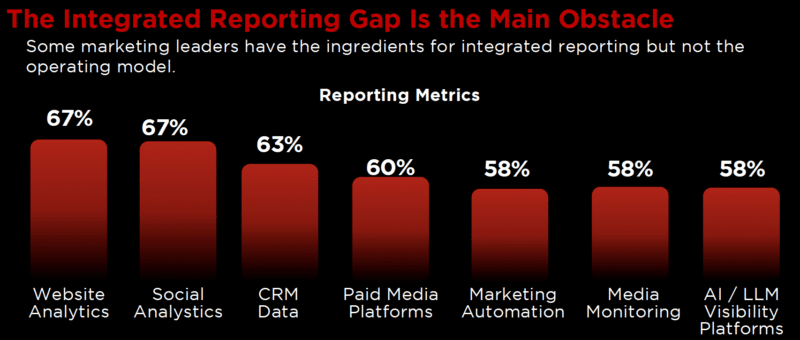
Respondents draw data from a wide range of systems: 67% use website analytics, 67% use social analytics, 63% use CRM data, and 58% use marketing automation data.
Only 35%, however, have fully integrated reporting across earned media, paid social, content, and digital channels. Another 19% have partially integrated reporting, while 18% have integrated reporting but unclear or inconsistent attribution.
Thirty-seven percent still use manual spreadsheets, and only 46% include reports from agencies or other partners. The data exists, but connecting a media placement, social interaction, or content engagement to what a buyer did next remains difficult.
Executives put more trust in business outcomes
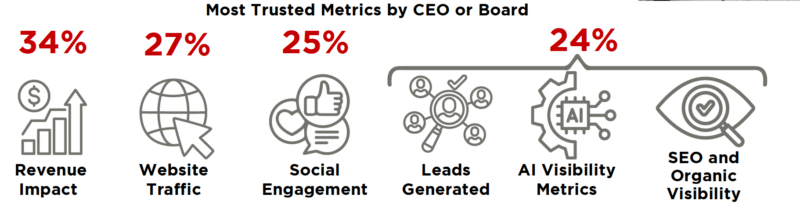
The research shows why those connections matter. Revenue impact ranks as the metric CEOs and boards trust most at 34%. Pipeline influence and media coverage volume each rank at 16%, while share of voice comes in at 11%.
Communications measurement is already moving further downstream: 48% track leads or conversions influenced by earned media, slightly more than the 45% who track the number of media placements or mentions.

When measuring what happens after someone engages, 51% track social ad click-through rates, while 41% track form fills or inquiries. Multi-touch attribution is the most common method for connecting communications to outcomes, used by 43% of respondents. Another 25% use correlation or directional analysis.
AI visibility adds another measurement layer
AI visibility adds another set of metrics for teams already struggling to connect marketing activity to business results.
Fifty-four percent measure AI search visibility or brand citations in AI-generated content. Forty-six percent include AI visibility or AI optimization in C-suite reporting, showing how quickly the metric has moved into executive conversations.
The world’s most powerful SEO platform, purpose-built for Enterprise.
Earned media is getting pulled into AI measurement, too: 42% track the number of LLM prompts citing their brand’s media coverage.
The next challenge is connecting that visibility to business outcomes. An AI citation can show that a brand appeared in an answer, but teams still need to understand whether that exposure contributed to a website visit, lead, opportunity, or sale.
Before adding more metrics, teams need to determine which signals help explain buyer behavior, which connect to business results, and which provide enough evidence to guide investment decisions.
The report can be downloaded here. (Registration required)
The post B2B marketers don’t trust the data used to shape budgets appeared first on MarTech.