If you listen to the hype, you’d think AI is already embedded in every marketing workflow. The reality is a lot messier. Research from Supermetric’s “2026 Marketing Data Report” shows that while leadership is pushing hard for AI adoption, most marketing teams are still figuring out how — or whether — to use it effectively.
Executive enthusiasm is outpacing operational readiness
AI adoption within marketing organizations is largely driven by leadership pressure, not bottom-up demand from practitioners. But the strategy, training and data foundations needed to support that push often aren’t in place yet.
According to the report, more than 80% of marketers say they feel pressure to introduce AI into their workflows. Yet only 6% say AI is fully embedded in their day-to-day operations. Most teams remain in the experimentation phase rather than using AI as part of core marketing processes.
That gap between ambition and execution shows up in several ways across the data.

The pressure to adopt AI is coming from leadership
The push toward AI adoption is largely top-down.
About 61% of respondents say the leadership team is the primary source of pressure to adopt AI, while 28% point to investor boards. Direct managers (26%) and customers (20%) are less common sources of pressure.
In other words, the excitement around AI often begins in boardrooms rather than in marketing teams.
That dynamic helps explain why many marketers feel pressured to adopt AI tools before their organizations have clearly defined how to use them.

Strategy and training gaps slow real adoption
Leadership enthusiasm hasn’t always translated into operational guidance.
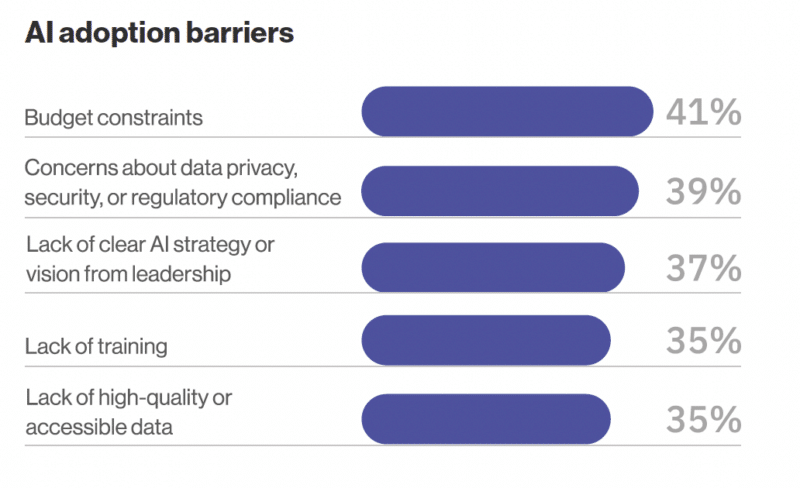
More than a third of marketers say they lack a clear AI strategy or vision from leadership. A similar share say they haven’t received enough training to use AI effectively in their work.
Without those elements, AI adoption tends to remain experimental. Teams may test tools for generating content or automating small tasks, but those efforts rarely connect to broader marketing goals.
As a result, AI becomes something marketers try occasionally rather than something that fundamentally changes how they work.
Privacy concerns and data readiness remain barriers
Trust issues are another factor slowing adoption.
Nearly four in ten marketers say they have concerns about AI data privacy, reflecting broader worries about security, compliance and responsible data use.
Budget constraints are the most commonly cited barrier to adoption, followed closely by privacy concerns and the lack of a clear AI strategy. Training gaps and limited access to high-quality data are also frequently mentioned challenges.
Taken together, these barriers show that most organizations aren’t struggling with the idea of AI. They’re struggling with the infrastructure required to use it responsibly and effectively.
AI is mostly used for the easiest tasks
Current usage patterns reinforce that point.
Most marketers are applying AI to relatively simple operational tasks. The report shows that improving efficiency and automating repetitive work are the most common reasons teams adopt AI tools today.
Those applications are useful, but they represent only a small portion of AI’s potential impact on marketing.
More advanced uses — such as accelerating analytics, uncovering insights or improving decision-making — require stronger data infrastructure than many organizations currently have.
The SEO toolkit you know, plus the AI visibility data you need.

AI could help solve the marketing analytics capacity gap
Ironically, one of the areas where AI could have the biggest impact is marketing analytics.
Many organizations operate with very small analytics teams. The report notes that a significant share of companies have fewer than five dedicated data and analytics specialists.
At the same time, marketers overwhelmingly believe stronger analytics capabilities would improve their effectiveness.
AI could help close that gap by accelerating data analysis and surfacing insights faster. But that will only happen if organizations invest in the data foundations required to support AI-driven analytics.
The takeaway
AI adoption in marketing is real, but it’s still early.
Leadership teams are pushing aggressively to introduce AI into marketing workflows. Yet most teams remain in experimentation mode, using AI primarily for small efficiency gains rather than strategic transformation.
Until organizations address the underlying gaps in strategy, training and data readiness, AI will remain more of a promising experiment than a fully integrated part of everyday marketing operations.
Go here to download Supermetric’s “2026 Marketing Data Report”. (Registration required)
The post Why most marketers are still only experimenting with AI appeared first on MarTech.