
As AI reshapes marketing, teams angling for a competitive edge must learn to use these new tools not just quickly, but effectively. Instead of counting logins or prompts, leaders need to recognize and cultivate the small minority of employees whose behaviors with AI actually drive impact.
New research shows that while most employees now use AI, only a tiny fraction qualify as truly sophisticated users — and their habits can be learned.
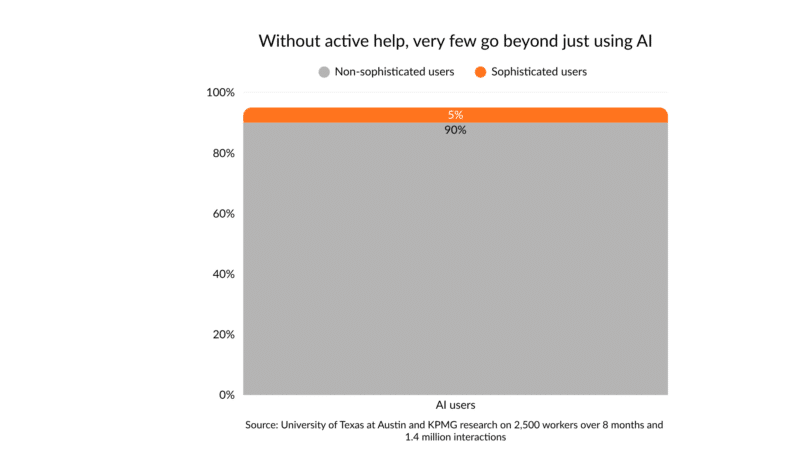
Researchers at KPMG and the University of Texas’ business school recently analyzed 1.4 million real workplace interactions with AI that took place over several months at the advisory, tax and audit firm.
They found that, although 90% of the 2,500 employees studied use AI, only 5% fit the researchers’ definition of “highly sophisticated.” These sophisticated users demonstrated their capabilities through behaviors that can be taught and advocated:
- Just do it. The most successful users have longer, more interactive sessions with more back‑and‑forth. They use AI frequently and intentionally, switching between models and tools based on the task at hand.
- Push back and iterate. They assign roles, feed examples of desired outputs, and treat the LLM as a thinking partner they guide over time.
- Don’t fear complexity. They delegate complex, multi‑step tasks with detailed instructions, constraints, and examples of the desired outcomes.
- Treat AI as a partner. They use AI for brainstorming, analysis, and exploration, not just shortcuts. Tellingly, informal language and a conversational tone often correlate with this more fluid, sophisticated use.
Zach Kowaleski, an assistant professor of accounting at the UT business school and one of the researchers, sums it up thusly: “Frequency — repetition helps. Ambition — ask for more. Persistence — don’t settle for the first response. Flexibility — play with different models so you get familiar with the different advantages they offer.”
How to operationalize good AI use
But the behaviors of the 5% won’t organically spread through an organization, nor do all users eventually become sophisticated with repeated use. Just letting employees tinker with available tools isn’t enough to drive “meaningful, value-creating use,” the researchers concluded.
Many leaders still treat AI as another software rollout, rather than a shift in how work and thinking occur. In a recent wide-ranging essay, media and technology big thinker Douglas Rushkoff likened the current pace of AI-driven change to the societal shifts that occurred when humans first developed writing. Not moveable type — writing!
“You don’t use a thinking, interactive technology for answers, or at least you shouldn’t,” Rushkoff said. “You engage with these new media for better questions, in a generative practice much more like the music of Brian Eno than the 19th-century ballad with beginning, middle and end.”
In other words, the most valuable AI use is learning to ask better questions and explore possibilities — exactly what the 5% are already doing.
The SEO toolkit you know, plus the AI visibility data you need.

Training is a necessity
Last year, a World Economic Forum survey found that, on average, 59% of employees will need additional training to meet evolving skill demands by 2030. “Countries and companies must evolve their strategies to enable collaboration and harness the complementary strengths of human intelligence and technology, or risk slower growth and being left behind in the next era of the global economy,” according to “The Human Advantage: Stronger Brains in the Age of AI.”
The UT and KPMG researchers advocate for a few new strategies, including:
- Codify AI‑first best practices. KPMG created playbooks, explainers, and peer networks that showcase what sophisticated AI use looks like in real work.
- Invest in hands‑on, scenario‑based training. They built training around real clients and internal tasks to build confidence and move people toward 5% behaviors.
- Set role‑specific expectations. They defined what “good work with AI” looks like for different roles and tasks, so employees knew how to aim higher than basic usage.
The goal is not just to celebrate the 5%, but to design the culture, training and expectations that turn ordinary AI users into high‑impact ones.
Key takeaways
- Most employees are using AI, but only a small minority use it in ways that drive meaningful impact.
- High-performing AI users treat it as a collaborative partner, not just a shortcut for quick answers.
- Sophisticated use comes from behaviors like iteration, experimentation and handling complex tasks, not just frequency of use.
- These skills do not spread naturally and require structured training, clear expectations and real-world application.
- Organizations that invest in developing advanced AI usage will outperform those that treat AI as just another tool rollout.
List generated by AI
The post What the top 5% of AI users do differently appeared first on MarTech.