
Open rate. Click-through rate. Ask most marketing teams how their email program is performing, and those are the numbers they’ll show you.
But here’s the problem: Open and click metrics don’t tell you whether your email program is actually working. They tell you how people interacted with the email message, not whether the email generated meaningful results for the business.
Relying on them as key performance indicators (KPIs) can lead to optimizing for the wrong outcomes entirely.
What the data shows about open and click rates
I’ve seen subject line A/B split tests where the version with the highest open rate produced fewer conversions or lower revenue per email (RPE) than the other versions. I’ve also seen campaigns where the version with the highest click-through rate generated fewer conversions or lower RPE than the other versions.
This isn’t just anecdotal. Looking across subject line tests I’ve conducted for a wide range of clients and audiences over many years, the results are striking.
The SEO toolkit you know, plus the AI visibility data you need.

Open rate as a KPI: Rarely useful
Many marketing teams use open rate as the primary KPI for subject line tests. After all, the subject line affects whether someone opens the email. But if your business goal is conversions or revenue, open rate is a weak proxy.
Across subject line A/B tests I’ve conducted using the scientific method, I went back to see how often the highest open rate was a correct predictor of the version with the highest conversion rate (for non-revenue actions) or RPE.

The data suggests that if your marketing department relies on open rate as a KPI for your subject line testing:
- 20% of the time, your results will correctly identify the version with the highest conversion rate or RPE.
- 10% of the time, your results will not correctly identify the highest-converting RPR version.
- 70% of the time, your open rate variance will fall within the margin of error and therefore be inconclusive, even when a clear highest-conversion-rate or RPE version exists.
Open rate either misled the analysis or provided no useful insight in 80% of the tests.
Click-through rate is even worse
If open rate isn’t a reliable KPI, some turn to click-through rate instead. That seems reasonable: clicks occur later in the funnel, so they should correlate more closely with conversions or revenue.
Unfortunately, the data suggests otherwise. Across campaign tests comparing CTR to conversion rate or revenue-per-email, the results of my analysis looked like this:

In this case:
- Only 7% of the time did the highest CTR version also produce the highest conversion rate or RPE.
- 36% of the time, CTR pointed to the wrong winner.
- 57% of the time, CTR differences weren’t statistically significant, even though the business metrics clearly were.
CTR was a reliable indicator of the true winner only 7% of the time.
The metrics that actually measure email performance
Diagnostic metrics like opens and clicks don’t reliably predict business outcomes. If you want to accurately evaluate email performance, you need to look at metrics that measure actual results.
Two of the most important are conversion rate and revenue per email.
Conversion rate: The metric that shows whether email works
Conversion rate measures the percentage of recipients who complete the action your email was designed to drive. A conversion doesn’t have to be a sale. It can be a purchase, a demo request, a webinar registration, a lead generation form, an app download or a subscription renewal.
Here’s the formula:
- Conversion rate = Conversions ÷ (Number of emails sent – Bounces)
- Multiply by 100 to express it as a percentage.
Conversion rate directly measures whether your email campaign is achieving its goal. It answers the most important question: Did the email cause the behavior we wanted?
This is why conversion rate is often the best KPI for campaigns designed to drive actions rather than immediate revenue.
Revenue per email: The metric that proves email ROI
For ecommerce programs, the metric I care about most is RPE.
- Revenue per email = Total revenue ÷ (Number of emails sent – Bounces)
- We present this metric as a dollar figure.
Unlike clicks or opens, this metric directly ties email performance to financial outcomes. It often reveals insights that engagement metrics hide.
For example, I once spoke with a company that sells high-end audio equipment. They had an aggressive A/B testing program and ran a test on whether to include product prices in their email. They used click-through rate as the KPI. Here were the results.
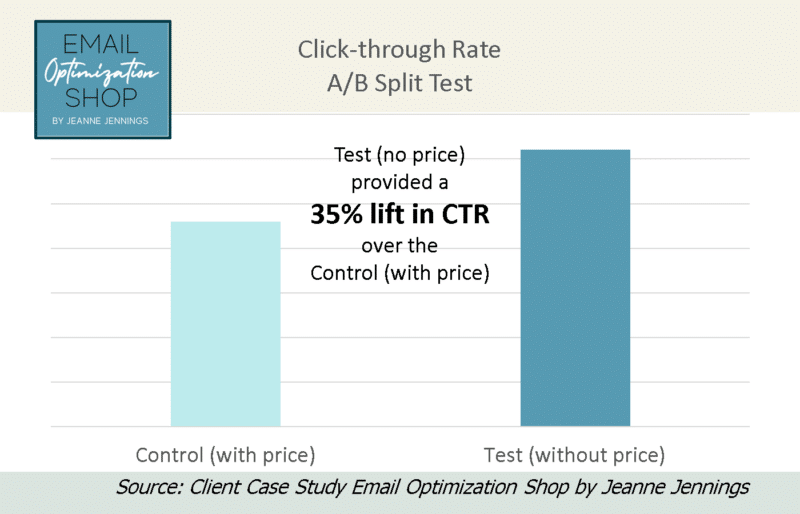
The version without pricing generated significantly more clicks, so it was declared the winner. But think about what’s happening here. High-end audio equipment is expensive. Many recipients likely clicked simply to find out the price. If the price had been included in the email, as it was in the control version, those recipients wouldn’t have needed to click.
The higher CTR version may simply have generated more curiosity clicks, not more clicks from qualified buyers. Because the company wasn’t tracking conversions or revenue back to email, they couldn’t determine which version actually generated more sales.
Without that data, the test winner is questionable at best.
The real lesson for email marketers
Open rates and click-through rates aren’t useless. They’re valuable diagnostic metrics that help you understand how recipients interact with your email content.
But they shouldn’t be the primary KPIs for most email programs. If your goal is conversions or revenue, and for most businesses it is, then your performance metrics should measure those outcomes directly.
That means focusing on:
- Conversion rate to measure whether your campaigns drive the desired action.
- Revenue per email to measure the financial impact of your program.
Because in the end, opens and clicks don’t make a campaign successful, outcomes do.
Author’s note: AI tools were used to assist with drafting and editing portions of this article. The testing data, analysis, and conclusions are based on subject line and campaign tests conducted for client email programs over multiple years.
The post The email metrics marketers are likely to get wrong appeared first on MarTech.