Ask any paid media manager how their Monday morning starts, and you’ll hear some version of the same story.
Google Ads. Meta. LinkedIn. TikTok. Reddit. Pull the numbers, drop them into a spreadsheet, make them tell a coherent story, and send the report to your client or boss by 10 a.m. Somewhere in there, figure out what worked last week and why.
It’s a terrible use of a Monday morning.
I’ve been in performance marketing long enough to remember when “multi-channel” meant running Google Ads and maybe a Facebook campaign on the side. That was already hard enough to reconcile. Now you’re dealing with 10 or 11 networks, each with its own attribution logic, campaign structure, and definition of a conversion.
The data doesn’t just live in different places. It doesn’t even speak the same language.
And yet most teams still manage everything the same way they did five years ago: too many tabs, spreadsheets, and Monday mornings.
The Monday morning problem nobody talks about
What doesn’t get discussed enough is that most of the time paid media teams spend on “campaign management” isn’t actually campaign management. It’s
- Data entry.
- Reformatting.
- Logging in and out of platforms.
- Rebuilding the same campaign brief five different times because Google’s campaign structure doesn’t map to Meta’s, and neither of them map to LinkedIn’s.
Industry data puts the average paid media manager at 5 to 9 hours a week on administrative work alone. My sense from talking to practitioners — and from doing the job myself — is that’s probably conservative for anyone managing more than three or four active networks. Agencies handling multiple clients across multiple platforms can easily spend twice that.
Think about what 10 hours a week actually means. That’s 40 hours a month — five full working days.
If you’re billing that time to clients, a meaningful part of the retainer isn’t going toward the work they actually hired you to do. If you’re absorbing it internally, it’s a hidden cost that never shows up in your ROAS calculations but absolutely shows up in your margins.
Every week.
And that’s before you get to the errors. Manual data transfer is really just manual error introduction — there’s no way around it.
- Budget caps get mistyped.
- Negative keyword lists don’t get updated across platforms.
- A campaign gets paused in Google while it keeps running in Meta because nobody caught it.
Small things, but small things compound.

What you’re actually losing (it’s not just time)
The time cost is real, but it’s not even the biggest problem. The bigger issue is the lag.
When your performance data lives in 12 different places and only gets consolidated once a week, you miss a meaningful optimization window between Monday and Friday.
The insight that LinkedIn is overspending while Google is underspending doesn’t surface until the budget’s already gone. The creative that stopped working on Wednesday doesn’t get flagged until Monday.
Another week of wasted spend.
There’s also a consistency problem that’s harder to see but just as expensive. When campaigns are built natively inside each platform — one brief rebuilt five times across five different UIs — the strategy starts to drift.
- Audience definitions stop matching exactly.
- Budget allocation logic becomes inconsistent.
- Creative strategy changes not because you made a deliberate decision, but because you were tired on Thursday afternoon by the time you got to the LinkedIn build.
For agencies, there’s another layer. You’re not just managing drift across networks, you’re managing it across clients. Thirty native dashboards. Thirty credential sets. Thirty reporting exports to manually combine every week.
I’ve been that person. It doesn’t get easier.
It’s a lot. And if we’re being honest, most teams have just accepted it as part of the job.
Why native dashboards will never fix this
I want to be direct about something: Google, Meta, LinkedIn, and every other ad network aren’t going to solve the cross-network management problem. Not because they can’t, but because they won’t.
Every platform is incentivized to maximize your time inside its interface. Time spent in Google Ads is time you’re not questioning whether Google deserves that budget. Same with Meta. Same with LinkedIn.
The fragmentation isn’t an accident. It’s the product.
Yes, they’ve all built APIs. Yes, there are integration ecosystems. But use any of them and tell me this feels solved. Managing a multi-network buy in 2026 still means logging into 10 different tools. The gap hasn’t closed — it’s just been covered with more software.
Anyway.
The solution has to start from the opposite direction: not “how do we stitch together the outputs of 10 platforms,” but “what if you never had to build inside those platforms in the first place?”
What AI-native management actually changes
The tooling shift happening in performance marketing right now isn’t really about dashboards. Dashboards are the symptom fix. The real shift is about who — or what — is doing the operational work.
AI-native ad management platforms handle the upstream work that lives in your team’s heads and your team’s time.
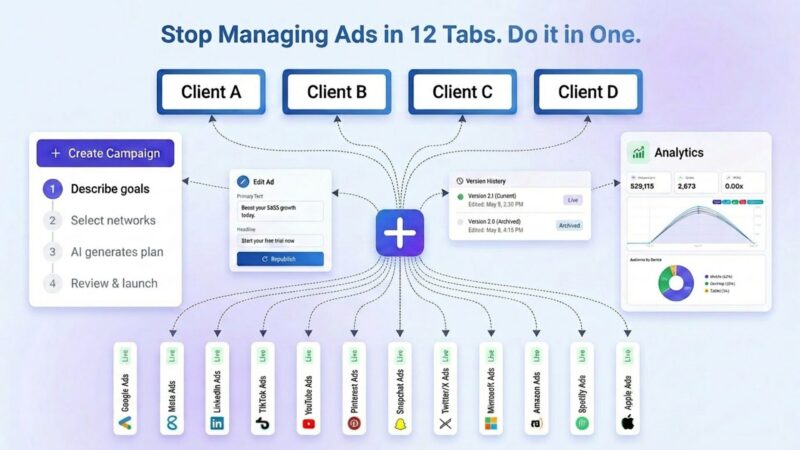
- Campaign planning from a plain-English brief instead of rebuilding logic for every platform.
- Creative automatically sized to each network’s specs instead of manually reformatted.
- Two-way sync on live campaigns so editing a headline in one place pushes the update across all 10 channels at once — no native dashboards required.
That last point matters because it changes the workflow itself. The old process for updating a live creative is: log into Google, pause the ad, upload the new version, publish. Then repeat the same process in Meta, LinkedIn, and TikTok. With two-way sync, you make one edit and the update propagates everywhere. The platform archives the old version and handles deployment.
That’s not a marginal improvement. That’s a different category of tool.

For agencies, the reporting side is probably the most immediately valuable. AI-generated client reports — normalized data, performance narrative, budget pacing — delivered in a branded format that’s ready to send. No more Sunday-night Excel ritual.
None of this is speculative. These platforms already exist, built specifically for teams that have been absorbing this operational overhead for years without a real alternative.
3 things worth doing this week
I’ll keep this practical:
1. Track where your hours actually go for one week.
Not roughly — actually track them. Before you evaluate a new tool or process, you need a real baseline.
Most teams I talk to underestimate their admin time by about 40%. Seeing the real number tends to motivate change faster than another article about it ever will.
2. Standardize naming conventions across every active account
Seriously. It’s unglamorous work, but the payoff is immediate. Inconsistent campaign names, ad set labels, and conversion event naming create a disproportionate amount of reconciliation pain in multi-network reporting.
Two hours of cleanup now can save hours every week going forward, no new tools required.
3. Evaluate what’s available now
This is the step most teams skip. The AI-native ad management space has moved quickly over the last 18 months.
If your mental model of “cross-channel management tools” is based on something you evaluated two or three years ago, it’s probably outdated. The gap between what the best tools can do today and what most teams are actually using is significant — and getting wider.
The operational edge is the performance edge
The teams winning in paid media right now aren’t necessarily the ones with the biggest budgets. They’re the ones that have compressed the cycle between data and action — teams that can see cross-network performance in real time, make changes across every channel at once, and get reporting out the door without losing half a day to manual work.
That’s an operational advantage. And operational advantages compound in ways that are hard to catch once another team has them.
The Monday morning spreadsheet reconciliation ritual isn’t inevitable. It’s just what the industry was stuck with until recently.
Written by:
Todd Gordon
Head of Growth and Performance at AdPlus
The post Your campaigns span 12 channels. Why does it feel like 12 jobs? appeared first on MarTech.