
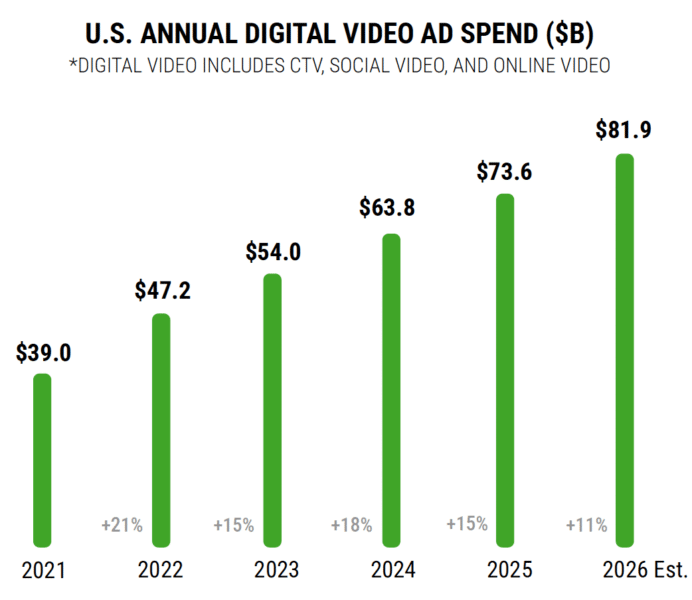
U.S. digital video ad spending is expected to reach $81.9 billion in 2026, doubling what advertisers spent just five years ago, according to IAB’s “2026 Digital Video Ad Spend & Strategy Report.” It is projected to grow 11% this year, nearly 20% faster than the overall advertising market, and, for the first time, account for 61% of all U.S. TV and video ad spending.
The report points to three major trends: Targeting has overtaken content quality as the top buying priority, social video continues to outpace connected TV, and agentic AI is moving into campaign operations while stopping short of making spending decisions.
Digital video’s growth is slower than the rapid gains of the post-pandemic years, but that reflects a larger, more mature market rather than weaker demand. Even in a year filled with the Olympics, World Cup, and midterm elections, events that traditionally favor linear TV, digital video continues to gain share.
Targeting becomes the new competitive advantage
The report found that targeting capabilities are now the most important factor buyers consider when deciding where to spend TV and video budgets. Nearly half of the respondents ranked targeting ahead of content quality, reach, guaranteed business outcomes, and price efficiency.
That reflects an ongoing difficulty in finding the right audience. Signal loss, fragmented identity, and AI-generated traffic are making it harder to know who advertisers are reaching and how well campaigns are performing.
Small and midsize advertisers’ emphasis on targeting rose sharply over the past year as they expanded into digital video while trying to avoid wasting impressions on audiences unlikely to convert. For these organizations, better targeting is often more valuable than broader reach.
Social video extends its lead
The growing importance of targeting explains why social video continues to pull ahead.

IAB projects social video spending will reach $31.9 billion this year, compared with $29.3 billion for connected TV. Nearly seven in 10 buyers now consider social video a must-buy channel, while CTV remains a close second.
The report attributes social video’s momentum to its combination of creator content, AI-powered personalization, commerce capabilities, creative optimization, and measurement. Those features make it easier for marketers to connect media investment with business outcomes.
Connected TV growth is based on premium programming, live sports, and expanding streaming rights, which continue to attract advertising dollars. Self-service buying platforms are bringing more small and midsize advertisers into the market. Much of that increased spending is taken from linear television budgets.
Social video’s growth extends well beyond consumer brands. Spending is expected to increase across nearly every industry IAB measured, from retail and technology to B2B and healthcare. Automotive is the only major category expected to decline.
AI continues to grow as an operational tool
Two-thirds of buyers are already using, testing, or planning to use agentic AI for digital video campaigns this year, while another 28% are actively evaluating it.
The report found marketers are using AI primarily where it improves decision-making rather than replaces it. Media planning, inventory evaluation, creative testing, performance analysis, and campaign optimization are among the top use cases because they enable AI to process large amounts of information before marketers decide how to act.
There is far less use of AI for spending or managing financial transactions. Buyers are far less comfortable with AI negotiating deals, executing purchases, or handling billing. That says as much about operational maturity as it does about technology. AI is becoming part of the workflow, but marketers still want people making the most important decisions.
The world’s most powerful SEO platform, purpose-built for Enterprise.
Different organizations are solving different problems
The report also shows there is no single path to adopting agentic AI.
Small and midsize advertisers use it to provide capabilities they lack. Creative testing, media preplanning, and performance analysis are their most common use cases because those tasks require more staff and expertise.
Larger advertisers’ priority is inventory discovery and evaluation, where AI helps analyze increasingly fragmented media markets spanning publishers, private marketplaces, direct deals, and open auctions. That shows organizations are applying AI to operational bottlenecks and have moved out of the assessment and adoption phase.
The report is based on Guideline billing and forward-booking data, market estimates, industry interviews, and a survey of 360 agency and brand advertising decision-makers conducted between Feb. 20 and March 13, 2026. Respondents were involved in digital video spending decisions and worked for organizations that spent at least $1 million on advertising in 2025.
The post Digital video enters a new era of competition appeared first on MarTech.