
Most marketing execs I chat with can quote benchmarks, know the latest tools, and keep up with the latest vendor reports. What they can’t tell me is where their own team sits on the AI journey. They know they’ve made progress… but where are they on that journey?
The signals most marketing leaders track (AI license counts, tool adoption rates, hours saved per week) are real, but they describe activity, not where your team stands. How does a leader articulate progress when the budget conversation is two weeks out?
Most budget conversations start with industry benchmarks, so let’s look at what they actually tell us before getting to the audit.
Salesforce’s State of Marketing 2026 found that 75% of marketers use some form of AI, with only 16% running anything genuinely agentic. Supermetrics’ 2026 Marketing Data Report puts full workflow adoption at 6%. Adobe’s State of Marketing in an AI-Driven World found that only 7% have achieved business results, plus that eight in 10 marketing teams missed an opportunity last quarter because they couldn’t respond fast enough.
The newest entry came earlier this month from Carnegie Mellon and Accenture, which released their AI Adoption Maturity Model on June 8. Drawing on surveys of nearly 600 practitioners, they reported that 95% of organizations realize no returns on AI investment, and only 8% have scaled AI to the enterprise level.
These numbers provide useful context for the broader market. They don’t answer the question you need before the next budgeting cycle: Where does your own team stand?
The world’s most powerful SEO platform, purpose-built for Enterprise.
Walking through the AI terrain
Most of the marketing AI scorecards now in circulation (Jasper, Salesforce, NinjaCat, the new SEI/Accenture release) compress maturity into a single-dimension score. A score works fine for a board deck. It’s a thinner tool for budget planning because it tells you your altitude without telling you what’s keeping you from the next step up. Because of that, work from a terrain map with seven stages.
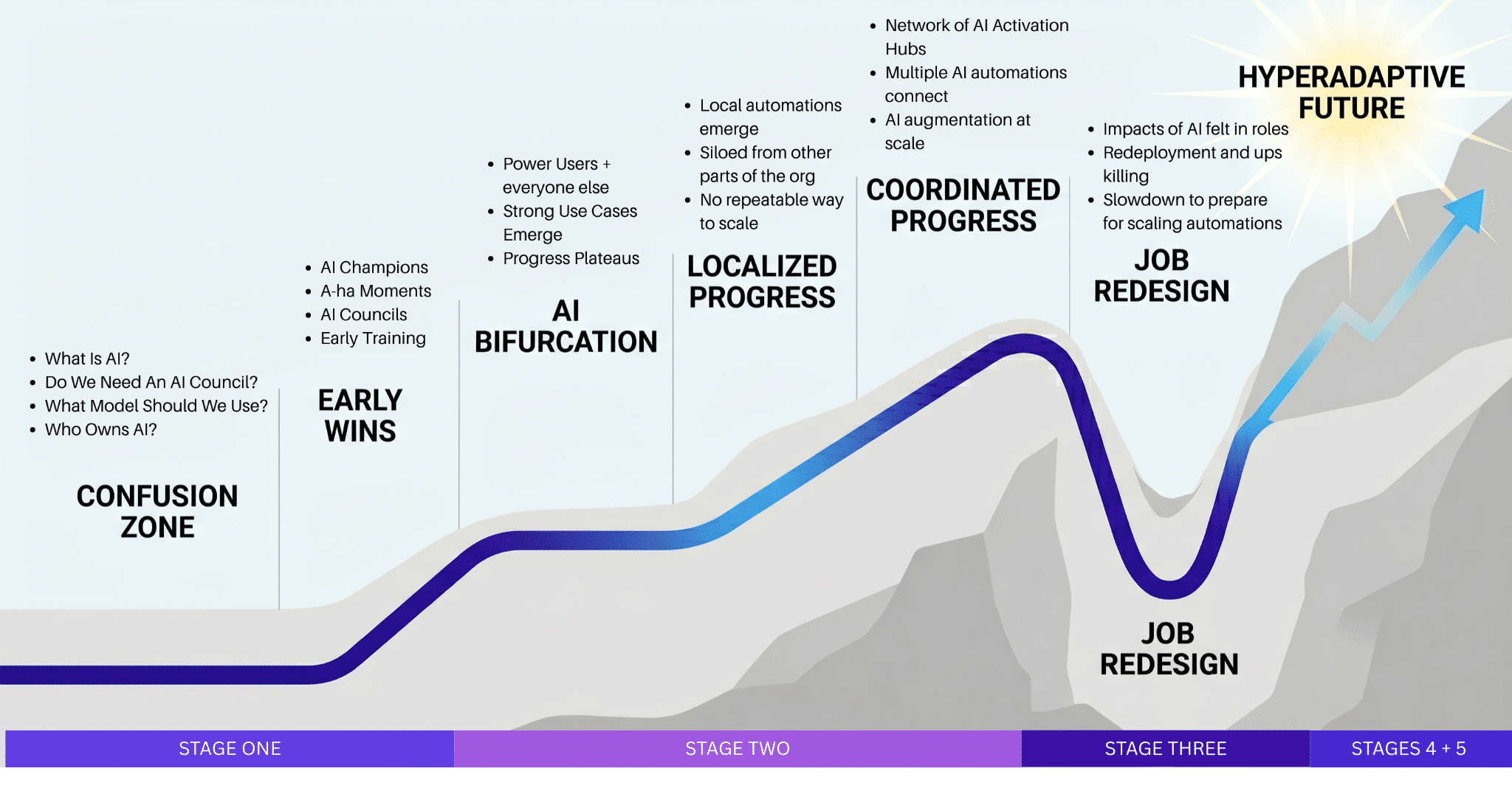
Here’s what each waypoint looks like inside a marketing team, with a diagnostic question that tests whether you’re there:
Confusion zone
Adoption is scattered. A memo went out. A few licenses got bought. Nothing structural moved.
- Diagnostic: Can anyone on the team articulate, in one sentence, what AI is for in marketing here?
Early wins
A handful of people figured out something genuinely useful (a brief generation flow, a content scoring loop, a faster competitive scan), and they can show you.
- Diagnostic: Can you name three recurring tasks where AI has measurably cut time-to-output in the last 90 days?
AI bifurcation
The team split. Power users pulled ahead of holdouts in ways that are hard to explain by skill alone.
- Diagnostic: If you ranked your team by “AI-assisted output per week,” would the top and bottom be in the same league?
Localized progress
Discrete functions (content, ops, demand gen, brand) each figured out AI inside their own swim lanes, while the handoffs between them still feel old.
- Diagnostic: When a campaign hands off from strategy to execution, where does AI stop and human re-keying begin?
Coordinated progress
Handoffs work. Shared use cases are documented. There’s a named AI lead or activation hub holding it together, and cross-functional campaigns move faster now, not just the individual tasks inside them.
- Diagnostic: Is there anyone other than the CMO who’s accountable for marketing AI adoption?
Job redesign
Roles changed on paper. The content strategist’s job description reads differently than it did a year ago, and so does the marketing ops lead’s. The org chart reflects what AI changed, not just what you bought.
- Diagnostic: When was the last time a marketing job description was rewritten because of AI?
Hyperadaptive future
Marketing operates as a continuously sensing, adapting value stream. Very few teams are here yet. If you are, you already know.
Sit with that list for a minute. When was the last time your leadership team had clear visibility into where each marketing function sits? Many of the marketing leaders I work with answer “never” to that question. Which is fine to admit. It just means the audit hasn’t been run yet.
What do you do with the results?
Two patterns emerge when marketers review the terrain map.
The first is that teams rarely remain at a single waypoint. Content might be in early wins while marketing ops reached localized progress, and brand is still working through the confusion zone. The AI bifurcation waypoint is the same phenomenon appearing at the individual level rather than the functional level. All of that matters when you think about what you’d like to fund next year.
The second is that most teams sit one or two waypoints behind where the marketing leader thought they were. That gap isn’t really about attention or care, but usually comes down to what’s being measured. License counts and adoption rates measure what was tried. Whether anything stuck is a different question.
As you think about next year’s funding, consider these three questions:
- What’s the highest waypoint anyone in marketing reached? (That sets the floor from which they can continue to climb.)
- What’s the lowest waypoint, and what would it take to move them up one step? (That’s a ripe spot for investment.)
- Is the gap between the highest and lowest growing or shrinking? (That’s your bifurcation read.)
Teams walking into planning with answers to those three will spend their AI budget very differently from teams walking in with a generic benchmark number.
Consider running this audit before your next planning meeting. You might discover your biggest AI investment opportunity isn’t where you expected.
The post Run this AI audit before your next budgeting cycle appeared first on MarTech.