
Marketers aren’t struggling to adopt AI. They’re struggling to make it work.
An Optimizely survey of more than 2,000 B2B marketers worldwide found that nearly half say AI is fully integrated into their day-to-day work. Yet most also spend hours every week correcting AI output, switching between disconnected tools, and compensating for processes that haven’t kept pace with adoption.
The report points to an operational challenge rather than a technology one. AI is becoming part of everyday marketing, but the governance, workflows, and technology infrastructure needed to support it are still catching up.
The promise of AI was greater efficiency. The reality is more complicated.
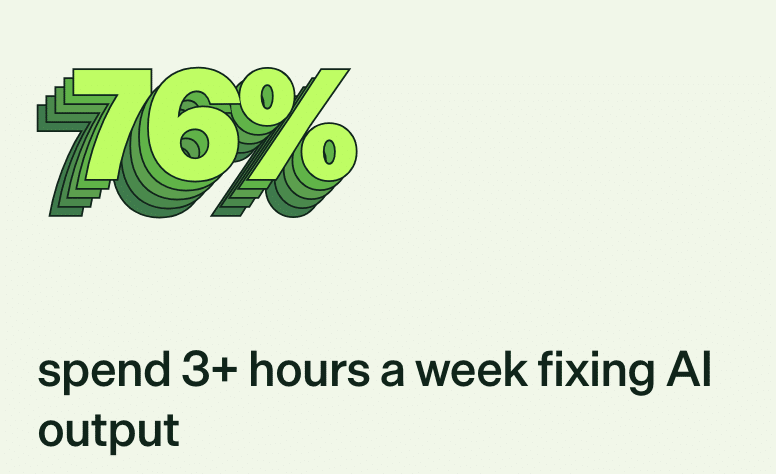
Three-quarters of respondents spend at least three hours each week editing, fact-checking, or fixing AI-generated content. Hallucinations, manual copy-and-paste between disconnected tools, and legal or compliance reviews consume much of that time. Just 4% said AI saves time throughout the entire content creation process.
AI created new work instead of eliminating it
The burden appears particularly high outside the U.S. While only 4% of marketers globally said AI saves time at every stage of the content process, U.S. marketers expressed significantly greater confidence in AI output. Thirty-nine percent said most AI-generated content is usable without significant editing, compared with 28% globally.

The findings show that AI hasn’t eliminated work so much as shifted it. Content generation takes less time, but quality control, governance, and coordination demand more attention.
Much of that additional work appears tied to the technology stack itself.
Only 19% of respondents use a single integrated AI platform. More than 80% regularly switch among multiple AI applications, creating disconnected workflows that require marketers to manually transfer information between systems.
Fragmented technology is amplifying the problem
Those disconnected environments make it harder to govern AI consistently. Teams spend more time verifying outputs, maintaining compliance, and ensuring information remains consistent across systems instead of building better customer experiences.

The report does not establish that fragmentation causes those outcomes directly, but the findings show they occur together across organizations adopting AI.
The survey also found that AI continues to struggle with one of marketing’s core responsibilities: preserving brand identity.
More than half of respondents said AI captures factual information but misses their brand’s emotional tone. Only about one-third expressed high confidence that their AI tools consistently reflect their brand voice.
Brand governance remains a human responsibility
U.S. marketers were more optimistic. Forty-five percent said they were highly confident AI captured their brand’s emotional resonance, compared with about one-third globally. Even so, 62% of U.S. respondents still expressed concern that AI is contributing to increasingly similar brand voices.

The concern extends beyond individual pieces of content. Fifteen percent of respondents said their AI-generated work would be difficult to distinguish from a competitor’s if branding were removed, while two-thirds expressed concern that AI is contributing to increasingly similar brand voices.
The findings reinforce that generating content is only part of the workflow. Maintaining differentiation still depends on editorial oversight, governance, and well-managed brand systems.
Leaders and practitioners see AI differently
The report also found a notable gap between executives and the people using AI every day.
More than half of marketers said leadership underestimates the human effort AI requires. C-suite respondents were considerably more likely than analysts to describe themselves as liberated by AI and to say their organization’s implementation is fully aligned.

The survey also found differences in behavior. Forty-four percent of C-suite respondents said they frequently or always submit AI-generated work without disclosing it, while one-quarter of marketing leaders acknowledged publishing AI-generated content they knew was off-brand to meet deadlines. In the U.S., that figure rises to one in three.
Rather than pointing to isolated governance failures, the findings show the operational pressure marketers face as AI adoption expands faster than the supporting processes around it.
The world’s most powerful SEO platform, purpose-built for Enterprise.
Adoption is no longer the challenge
Perhaps the report’s most striking finding is that 65% of marketing leaders would consider pausing their AI rollout for 90 days to rethink their approach. Only 35% believe their current implementation is on the right track.
As with any vendor-sponsored research, the findings reflect marketers’ perceptions rather than independently measured productivity. Even so, they point to a consistent theme. Marketing organizations have largely adopted AI. The harder challenge is building the governance, integrated technology, and operating model needed to make AI reliable at scale.
For enterprise marketers, the competitive advantage no longer comes from adopting AI. It comes from operationalizing it.
The post Time saved by using AI is being spent on managing its output appeared first on MarTech.