
It usually comes up on a call between the traffic recap and next quarter’s plan. A client asks whether they appear when someone types a question into ChatGPT. Most agencies still don’t have a real answer.
That question is now everywhere.
In AgencyAnalytics’ 2026 Marketing Agency Benchmarks Report, based on responses from 494 agency professionals, 66% said helping clients appear in AI-driven search is the top new service clients are requesting. It ranked ahead of performance-based paid ads and short-form video, both of which have been building for years.
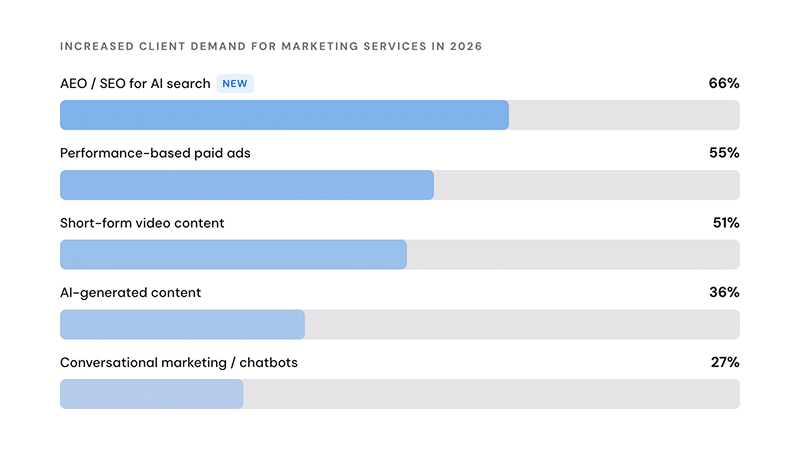
AI search went from a curiosity to the top client request in a single year. Demand is real and rising fast. What comes next is harder.
Demand outran measurement
Agencies feel the shift, but feeling it and measuring it are different. In the report, 64% named Google’s AI Overviews their top industry concern.

At the same time, 48% said they can’t reliably track people who discover a brand through AI tools, and 47% can’t attribute conversions across the multi-session journeys AI-assisted research creates.
Rank tracking was built for blue links. It can’t show whether an AI-generated answer names a client, how it describes them, or which sources shaped the response.
So when a client asks how they’re doing in ChatGPT, most agencies have to admit they can’t tell. That’s a hard answer to give someone paying to know.
What agencies can actually measure now
AI search visibility is no longer a black box. Four things are trackable today, and together they provide a real answer:
- Visibility: Whether a client appears when a prompt relates to their business.
- Position: How prominently they appear.
- Sentiment: How the AI describes them (positive, neutral, or a problem worth flagging).
- Citations: Which URLs the model relies on to build its response, revealing whose content shapes the answer.
Track those four over time across engines like ChatGPT and Gemini, and “Are we showing up?” becomes a chart an agency can put in front of a client.
Where that tracking lives matters as much as what it measures. AgencyAnalytics built AI Tracker into the same platform more than 7,000 agencies already use for reporting, so AI search visibility sits beside the traffic, leads, and revenue they already track.

Unlike a standalone tool, AI Tracker tells one connected story: where a client appears in AI search and what it’s doing for the business. It uses a shared pool of credits across an agency’s entire client base, with no per-seat math as clients are added.
A bolt-on tool can report a metric. Connecting AI visibility to marketing results explains what it means.
Getting the data where the work happens
There’s a second half to the equation: where agencies actually work.
More of an agency’s day now happens inside AI tools. An account manager is reviewing a client’s performance in Claude or ChatGPT, then stops, switches tabs, pulls a number from a dashboard, and brings it back into the conversation.
AgencyAnalytics MCP closes that gap. It connects live client data to the AI tools agencies already use, so they can ask about performance without leaving the conversation.

Every query is scoped to a specific client, and existing permissions carry over, so agencies only see the accounts they’re authorized to access. AI Tracker data reaches the team where they’re already working instead of sitting in a dashboard someone has to remember to open.
Together, AI Tracker and MCP simplify the workflow: measure how clients appear in AI search, then bring that data into the tools where analysis and writing happen.
Why this is a retention problem, not just an SEO one
It’s tempting to file AI search under SEO and move on. That undersells what’s at stake.
The top question clients ask, cited by 55% of agencies, is whether marketing connects to actual revenue.

That question reflects a broader shift in what clients now expect.
“Agencies are being asked to do a different job than they were a year ago,” said AgencyAnalytics CEO Joe Kindness. “Clients want to know if they show up in ChatGPT, they want answers the moment they ask, and they expect proof tied to revenue. We work with 7,000 agencies serving 150,000 clients, so we see these shifts early. AI Tracker puts that visibility into our customers’ hands.”
An agency that can show where a client appears in AI results, alongside the revenue that visibility supports, is having a very different conversation. One looks prepared for where the market is going. The other is left without an answer to a question the client already cares about.
The shift is already here. Agencies that can measure and report on it will answer the ChatGPT question with data. The full picture of what’s changing, and how agencies are responding, is in AgencyAnalytics’ July launch of its new AI features.
The post Your client just asked if they show up in ChatGPT. Now what? appeared first on MarTech.